Innovative finance
Humanitarian needs are growing faster than traditional funding can keep pace. Grants remain essential, but they are often uncertain, late, or short-term. Through Innovative Finance, the IFRC is expanding how humanitarian action is funded — unlocking new resources, building strategic partnerships, and developing mechanisms that make funding more predictable, sustainable, and scalable.
Our vision
Our vision is to build a resilient and sustainable humanitarian financing system that empowers local actors and communities. By combining humanitarian expertise with financial innovation, we aim to reduce reliance on short-term grants by mobilizing diversified, long-term resources.
Our approach to Innovative Finance allows us to:
- Access new types of capital from governments, companies, and philanthropies.
- Multiply the impact of donors’ contributions by blending grants with loans or co-investments.
- Develop market-based solutions that generate income and strengthen community resilience.
The three pillars of IFRC's innovative financing strategy
To achieve this, we focus on three complementary pillars — translating innovation into financial mechanisms that deliver greater humanitarian impact.

Securing pre-arranged funding
There is growing recognition that pre-arranged financing and anticipatory action are among the most effective and efficient ways to save lives and build resilience. This approach secures funding before disasters strike, so communities receive help faster — without waiting for emergency appeals, even in times of extraordinary demand. It provides predictable, timely resources to address increasing climate and disaster risks, while reducing uncertainty by transferring risk to financial markets.

Building long-term recurring income
Sustainable and predictable income allows National Societies to plan beyond short funding cycles and maintain vital community programmes year after year. Generated through investment returns from endowment funds, this approach ensures financial continuity and long-term support.

Scaling financially sustainable solutions
Developing financially sustainable models attracts co-funding, strengthens community resilience, and enables long-term impact. This pillar catalyses investment in scalable, income-generating projects across climate, health, water, and food security - mobilizing and blending diverse sources of financing to strengthen resilience in fragile and humanitarian contexts.
Innovation: it’s about more than funding
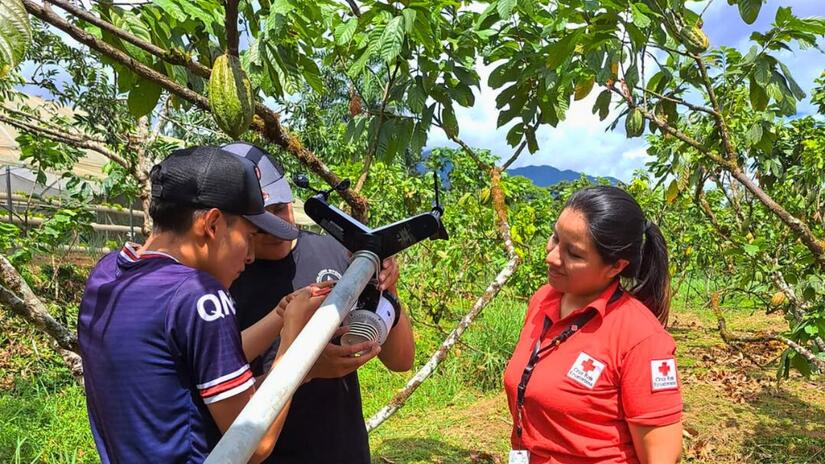
Two cocoa producers install the Early Warning System ‘SATHEOBROMA’, with the help of an Ecuadorian Red Cross volunteer.
Foto: Ecuadorian Red Cross
At the IFRC, innovation goes beyond funding. It’s about finding new and better ways to deliver humanitarian action, improve efficiency, and reduce costs — not only in our operations, but also in the costs that crises impose on affected communities.
We do this every day through community-level preparedness, prevention, and anticipatory action. These approaches are not only more effective at saving lives and livelihoods — they also save millions in donor funding each year. For every dollar invested in prevention, an estimated six dollars are saved in response.
Innovation happens at every level of the IFRC network.
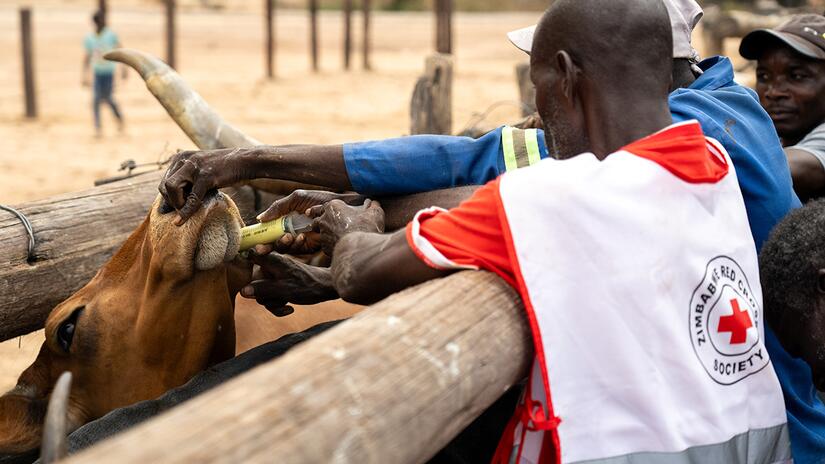
A Zimbabwe Red Cross volunteer assists community members with administering oral medicine to cattle in Siachilaba, Binga district — part of an anticipatory action campaign to protect livestock before the dry season hits.
Foto: Alexander Uggla / Finnish Red Cross
At our global innovation hub, the Solferino Academy, young volunteers in Ecuador developed a digital tool that helps cocoa farmers predict when pests are likely to strike — protecting both their crops and their income. At a larger scale, the IFRC has been a leader in humanitarian cash assistance, helping to manage one of the largest cash-transfer programmes in history, and is a key partner in global efforts to advance anticipatory action and early warning systems.
We’re also finding new ways to connect communities and expand solidarity with those facing conflict, climate shocks, and other crises. Through the Islamic Humanitarian Giving Initiative, the IFRC is strengthening partnerships with faith-based institutions to channel resources directly to people in need.
At the same time, regional campaigns such as Africa Zero Hunger and the Red Family Fund are building new local and regional funding bases — bringing innovation closer to the communities we serve.
Multiplying impact through innovative finance
Through innovative finance, the IFRC is making humanitarian funding more predictable, sustainable, and scalable by:
- Securing funding before disasters strike.
- Building reliable, long-term income streams.
- Leveraging grants, partnerships, and co-investments to multiply impact.
- Doing more with less by combining humanitarian and financial innovation.
For donors and partners, innovative finance ensures that every contribution achieves more. By leveraging grant capital, the IFRC and its partners multiply humanitarian impact — delivering greater and longer-lasting results for people and communities in need.