
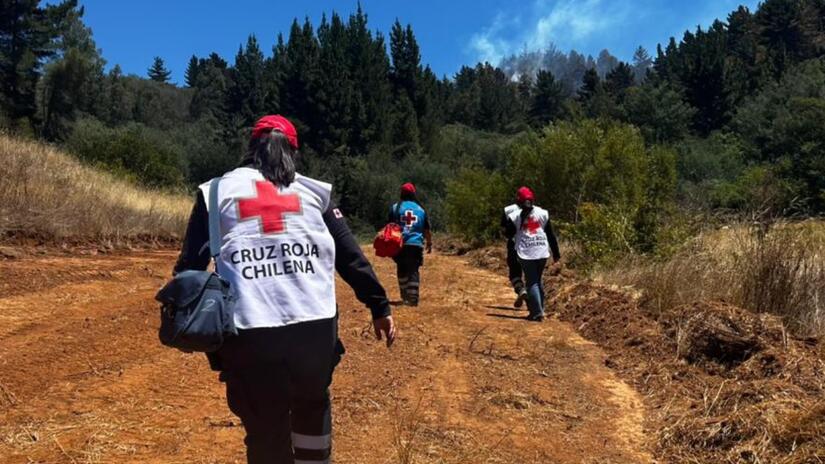
La semana pasada, la IFRC asignó medio millón de francos suizos de su Fondo de Emergencia para la Respuesta a Desastres (IFRC-DREF) para reforzar la respuesta de la Cruz Roja Chilena a la emergencia por incendios forestales a gran escala que comenzó en enero en las regiones de Ñuble y Biobío, en el centro del país.
"El 18 de enero, estos incendios se descontrolaron y se propagaron rápidamente debido a las condiciones meteorológicas adversas y a un cambio repentino en la dirección del viento, conocido localmente como viento puelche, que en pocas horas llegó a barrios muy poblados", se menciona en el IFRC-DREF.
Los incendios evolucionaron rápidamente y las autoridades declararon la catástrofe ese mismo día, desplegando todos los recursos del sistema nacional de respuesta.
"La emergencia ha tenido importantes repercusiones humanitarias, entre ellas evacuaciones masivas (de unas 50 000 personas), pérdidas de vidas humanas, daños en viviendas, interrupción de los medios de subsistencia y alteraciones significativas en el acceso a los servicios básicos y las infraestructuras críticas", añade el IFRC-DREF.
La Cruz Roja Chilena activó anteriormente su protocolo de acción temprana simplificado para incendios forestales, el primero de este tipo en el mundo, y destinó 95.000 francos suizos para ayudar a 2.000 personas.
El cambio climático provocado por la actividad humana ha triplicado la probabilidad de que se den las condiciones meteorológicas propicias para los incendios que han arrasado recientemente Chile y Argentina, según un nuevo análisis publicado hoy por World Weather Attribution, también se ha demostrado que La Niña ha tenido un papel menor en el aumento de la sequía.
‘Massive impact in multiple areas’
The scientists say these regions are getting up to 25 per cent less rainfall than they would have in a world without the burning of fossil fuels, while the fires were also driven by temperatures approaching 40°C and winds of some 40kph.
The province mainly affected in Argentina, Chubut, includes the Los Alerces National Park in Patagonia that borders Chile and is listed as a World Heritage Site by UNESCO.
Argentine scientist Juan Antonio Rivera of the Scientific and Technological Center in the central city of Mendoza and a WWA study author said: “These fires are striking at the heart of our communities and natural heritage. In Patagonia, we are seeing blazes threaten the Alerce trees – ancient giants that have stood undisturbed for thousands of years."
“The combination of human-induced warming and natural cycles like La Niña has created an aridity that fires thrive on. For Chile and Argentina, the drying of our landscapes is no longer a projection but a crisis that needs an urgent response to protect our unique biodiversity and the people of our region.”
The WWA statement today said that “iconic landscapes, glacial lakes, mountain towns, and peak summer tourism hubs, quickly became evacuation zones as fires advanced along the eastern slopes of the Andes.”
The Climate Centre’s senior urban specialist Aynur Kadihasanoglu adds: “In Chile, the proximity of flammable pine plantations and human settlements puts lives and livelihoods at risk … To save lives, we must address not only the emissions driving rising temperatures, but also the local exposure that leaves communities so vulnerable.”
The Chilean Red Cross has been involved in wildfire emergencies at the national level in 2012, 2014, 2017, 2022–23, and 2024, assisting thousands of affected people, but “the increase in the frequency and intensity of these threats due to climate change and population flows to areas of urbanization not regulated by the state have transformed these scenarios into events with massive impact in multiple areas,” IFRC-DREF says.