
Uneven rains, unequal impact
Drought and hunger in Northern Kenya. The IFRC and the Kenya Red Cross respond but more urgent support still needed.
A country going through a climate of extremes
Across Kenya, the March-April-May (MAM) long rains season unfolded unevenly. In parts of the country, the rains arrived with force.
Nairobi, central, and western regions have experienced episodes of flooding that have disrupted transport, damaged homes, and displaced families.
While excess rainfall is shaping daily life in these areas, other regions are facing a very different reality.
When the rains do not come
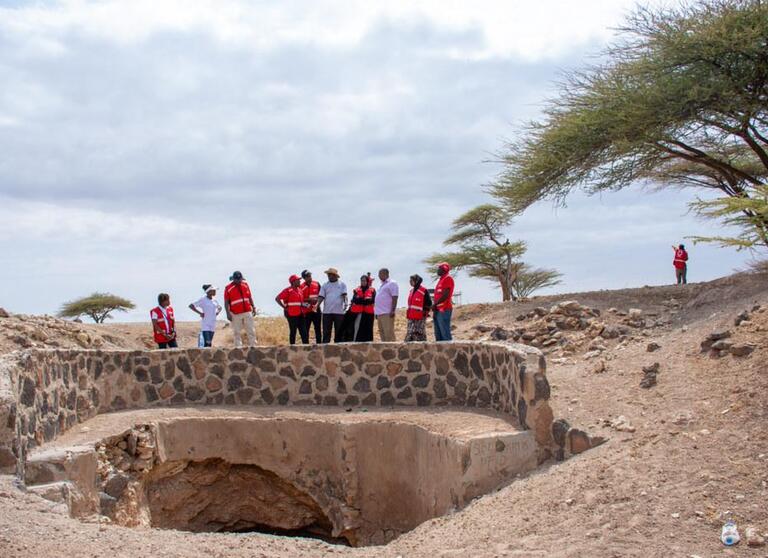
In eastern and northern Kenya, including Turkana County, the long rains have been minimal or absent. For communities already weakened by successive dry seasons, the contrast is stark.
Rainfall that has eased conditions elsewhere has not reached these arid and semi-arid landscapes, and where light showers have occurred, they have been insufficient to reverse months of deterioration.
Seasonal data confirms what households see every day. Rainfall in recent months has remained well below the long-term average, with poor distribution over time and space. Vegetation condition has declined sharply; pasturelands have failed to recover, and many riverbeds and shallow wells have dried completely.
In agro-pastoral zones, earlier crop losses have left households without reserves. The long rains, even if they improve slightly, cannot undo the cumulative impacts of previous droughts that wiped out forage, farmland productivity, and livestock assets.
In Turkana, the impact of this slow onset crisis is visible across the landscape.
Grazing areas are bare; villages that once relied on nearby water sources now depend on distant and unreliable points, and livestock routes stretch farther as animals are moved in search of pasture and water. Milk production has dropped sharply, removing an important source of nutrition for children.
Silence in the fields
When walking around the fields and countryside among the villages here, the parched earth and withering vegetation are not the only things that stand out. Perhaps one of the most striking features of this arid landscape is the silence.
There are no animals wandering about the fields. No braying goats or cattle. Asked where the animals are, Mzee Eyanae Eperit explains that families were forced to move their herds far from home.
“We had to relocate all our goats to the highlands near the Ugandan border where we can find pasture,” he says.
The strain of the season is visible in his slow, deliberate speech and frequent pauses. With schools currently on holiday, he adds, the situation has become even more worrying.
Families once relied on school meals as a critical source of nutrition for their children, but that support is now unavailable.
With fields emptied of livestock, Mzee Eyanae Eperit (left) explains how families moved their herds toward the border in search of pasture, a harsh season weighing heavily on the community as worries deepen with children at home from school. Photo: KRCS/Gidraph Mbugua
With fields emptied of livestock, Mzee Eyanae Eperit (left) explains how families moved their herds toward the border in search of pasture, a harsh season weighing heavily on the community as worries deepen with children at home from school. Photo: KRCS/Gidraph Mbugua
Turning to wild foods to survive
As livestock are pushed farther away, households increasingly depend on alternative means to survive. One such resource is Hyphaene thebaica, locally known as Mkoma. In this harsh environment, the doum palm has become a lifeline.
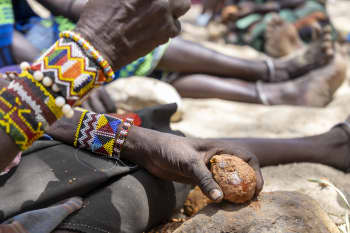
Women and children walk long distances to gather the fallen fruits, as shown in the adjacent video. The hard shells of the drum palm nut are cracked; the pulp is soaked and softened, then shared at home to provide a small bit of sustenance and to ease the hunger pains.
When the well runs dry
In Ekal Loyeit’s manyatta (hut), this reality is clear. She sits beside a makeshift cooking area, preparing doum fruit for her three children.
The family moved closer to a dry riverbed in search of water, relying on a shallow well that is slowly failing.
Her eldest child is visibly weak and malnourished, reflecting the toll of prolonged hunger.
In Lopur, Turkana, Kenya Red Cross drought and nutrition assessments revealed the growing toll.
Children under five and pregnant and lactating mothers facing moderate to severe malnutrition (MAM-SAM) were identified and enrolled in nutrition therapy, offering a critical lifeline amid shrinking options.
Unsafe water, no alternatives
Ekal explains that she lost all her goats during the height of the crisis, when food became too scarce and the sacrifices too great.
“It was my only way of making a living,” she says.
Later, she walks to a nearby water point where several villagers gather. The water is cloudy and unprotected, but there are no alternatives.
People drink it anyway, as animals press in alongside children, all competing for the same diminishing resource.
Finding solutions to survive
A woman uses a rock to break the shell of a doum palm fruit. The seed inside is then removed and the casing is soaked until it is soft enough to be eaten.
This recipe of necessity does not replace a full meal, but it eases hunger, especially for children, and it offers something to hold on to in a time of scarcity.

A Kenya Red Cross team member screens a child for malnutrition in Lopur, Turkana, as drought drives rising food insecurity and vulnerability among children and mothers.
A Kenya Red Cross team member screens a child for malnutrition in Lopur, Turkana, as drought drives rising food insecurity and vulnerability among children and mothers.

Community members gather for Kenya Red Cross mass screening for malnutrition among children under five in Lopur, Turkana.
Community members gather for Kenya Red Cross mass screening for malnutrition among children under five in Lopur, Turkana.

KRCS staff members review wall charts showing the number of children screened for moderate and severe malnutrition at a community health centre in Lopur, Turkana.
KRCS staff members review wall charts showing the number of children screened for moderate and severe malnutrition at a community health centre in Lopur, Turkana.
This crisis is not happening in isolation
While floods in parts of Kenya demand urgent response, drought affected communities are facing a quieter emergency that unfolds over months rather than days.
It reflects the increasing climate variability affecting the country, where excess rainfall and deepening drought occur at the same time.
The IFRC network and its partners have a vital role in responding to these overlapping climate extremes. Addressing immediate humanitarian needs while strengthening resilience is essential to help communities withstand future shocks.
The IFRC and Kenya Red Cross response
Under the Federation-wide IFRC Emergency Appeal for Kenya: Complex Emergency, KRCS is delivering a coordinated, multi-sector response combining food assistance, safe water, health and nutrition services, cash, and livelihoods support.
This builds on early action and interventions supported by IFRC’s Disaster Response Emergency Fund, which was activated as conditions deteriorated from late 2024 into 2025 and enabled rapid, targeted scale-up of the crisis response.
The approach integrates emergency response, early action, and resilience-building through community-led, multi-sectoral interventions tailored to local needs.
Water, sanitation and hygiene (WASH)
KRCS has prioritized access to safe and clean water through a combination of emergency water trucking, rehabilitation of strategic water points such as borehole solarization and establishment of function water kiosks and livestock watering points.
To date, the KRCS national drought portfolio reports 63,024 people have been supported with safe water alongside hygiene promotion through provision of water treatment chemicals such as PUR and aqua tabs.
Field updates from Mandera county illustrate this integrated approach: after mass livestock deaths were recorded in Rhamu (Chabii Barr), KRCS rapidly delivered 28,000 litres of safe water alongside medical outreach for vulnerable households.
Food security and livelihood
In area where markets are not feasible, weak or inaccessible, KRCS is doing the in-kind food distribution and supporting livestock protection through animal feeding supplements, veterinary outreach and strategic water access.
Complementary school food interventions are helping maintain school attendance and protection of child nutrition in drought affected areas.
In Marsabit county (North Horr), KRCS reports reaching 5,200+ households through such integrated packages, including targeted feed support alongside emergency water and food, an approach designed to stabilize incomes and prevent deeper asset loss while broader conditions remain crisis‑level.
Health and nutrition
In Mandera North (Ashabito/Guticha/Morothile), an IFRC‑supported KRCS intervention reached 4,987 households with a combined package of emergency water, health and nutrition services and Corn–Soy Blend Plus Plus (CSB++), a fortified, nutrient-rich food made from corn and soy, enriched with essential vitamins and minerals (and often added oil and sugar). CSB++ is used to prevent and treat malnutrition among vulnerable populations.
In Turkana and Baringo counties, KRCS supported 20 schools with fortified porridge as part of a school‑based safety net that reached about 6,120 children for one term together with their parents, coordinated through the County Steering Group to avoid duplication. In total, KRCS reports 42,058 children under five provided with nutrition services to date under this drought response.
Multipurpose cash assistance (MPC)
Where markets are functioning, KRCS is scaling unconditional cash transfer modality to enhance household purchasing power and dignity.
Cash and voucher assistance are coordinate through the County Steering groups and aligned with the Kenya Cash Working group guidance to avoid duplication and maximize on the impact.
To date, 5,400 households have received emergency cash transfers under the drought portfolio. A recent example is Turkana county, where KRCS working with the County Steering Group and supported by Danish Red Cross registered 2,000 vulnerable families for cash while supporting 10 schools with food; the intervention was explicitly mapped against other partners to prevent overlap and close priority gaps.
Unpredictable future; dire need for further support
As climate patterns grow more unpredictable, timely, flexible, and well targeted support will determine whether households can recover or are pushed deeper into crisis.
For families in northern Kenya, hunger is not an abstract indicator. It is a daily reality shaped by failed rains, depleted pasture, and long journeys for water. The long rains alone cannot reverse what successive droughts have stripped away.
Without sustained action, the gap between those experiencing floods and those enduring drought will continue to widen, leaving the most vulnerable further behind.
Credits:
Story by Timothy Maina, IFRC Communications Officer and Gidraph Mbugua, KRCS Audio-visual Officer
Photos and video provided by Gidraph Mbugua/Kenya Red Cross

 Built with Shorthand