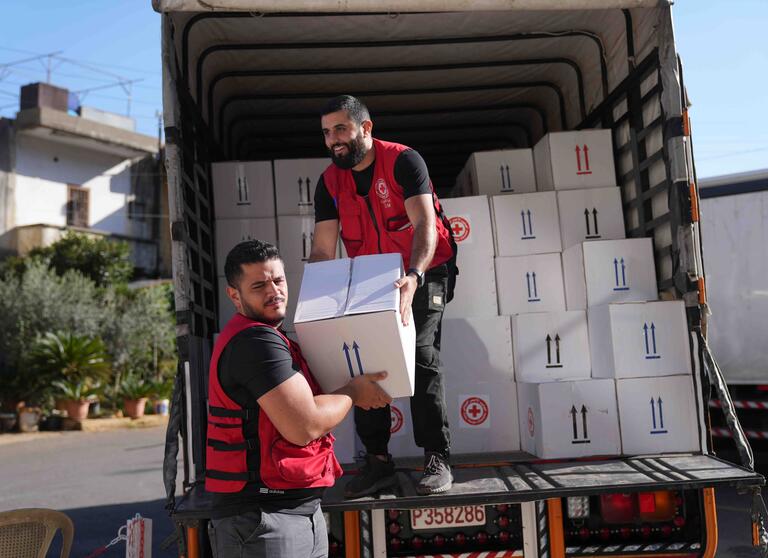

Beirut/Tehran/Geneva, 26 May 2026 — Three months since the escalation of hostilities in Lebanon and Iran, the International Federation of Red Cross and Red Crescent Societies (IFRC) is warning that multiple silent humanitarian crises are deepening across the region — with long-term consequences for health systems, food security, displacement, and community resilience.
While international attention has shifted elsewhere, millions of people continue to face displacement, damaged healthcare systems, disrupted livelihoods, and growing challenges to accessing essential services. Ongoing geopolitical tensions and restrictions affecting regional transportation routes, including through the Strait of Hormuz, continue to hinder humanitarian supply chains and increase the cost of delivering aid.
“Behind the headlines, multiple silent crises are deepening with consequences that will last for years,” said Cristhian Cardoza, Deputy Regional Director for the Middle East and North Africa (MENA) at the International Federation of Red Cross and Red Crescent Societies (IFRC). “Families are being pushed beyond breaking point — struggling to afford food, medicine, fuel and shelter, while damaged health systems, displacement, and economic pressure continue to drive humanitarian needs higher every day.”
Health systems under severe strain in Iran
In Iran, the humanitarian consequences of the escalation continue long after the ceasefire. The conflict has seriously disrupted healthcare delivery nationwide, including 56 Iranian Red Crescent Society (IRCS) centres nationwide.
For patients living with chronic illnesses, disruptions to healthcare and medical supply chains are becoming life-threatening. Restrictions affecting transport routes continue to complicate access to critical medicines and equipment.
Despite the pressures, IRCS teams have continued large-scale humanitarian operations across the country, including search and rescue, emergency medical care, and psychosocial support services.
Food insecurity deepens across Lebanon
Another alarming trend is rapidly emerging: nearly one in four people in Lebanon — around 1.24 million people — are now expected to face acute food insecurity between April and August 2026, according to analysis from the Integrated Food Security Phase Classification (IPC).
The deterioration is being driven by continued hostilities, prolonged displacement, economic collapse, and soaring fuel prices. Fuel prices in Lebanon have risen sharply since the escalation, with diesel increasing by more than 65 per cent, according to the World Food Programme. At the same time, the Minister of Agriculture has warned that approximately 22 per cent of agricultural land in affected areas has been damaged, further undermining food production and livelihoods.
Over 1 million people in the country are currently displaced, with many people, especially from the south, unable to return home due to ongoing hostilities and destroyed infrastructure, now living in tents following the intense recent hostilities.
Protection concerns and funding gap threaten humanitarian response
The IFRC also reiterated urgent concerns over attacks affecting healthcare workers, ambulances, and humanitarian responders. In Iran and Lebanon combined, six Red Cross and Red Crescent volunteers have been killed while carrying out humanitarian work since the recent escalation.
“Our teams on the ground are clear - what they need above all else is protection,” said Mr Cardoza. “These brave staff and volunteers should not have to fear for their lives when they get an emergency call and travel in their ambulances. “Hospitals, ambulances, medical personnel and humanitarian workers must be respected and protected.”
The IFRC warned that severe funding shortfalls are threatening the continuity of humanitarian operations across the region.
“Behind these numbers are real consequences,” continued Mr Cardoza. “Operations may need to be scaled back, supplies delayed or cut, and there will be people we cannot reach.”
The IFRC’s Emergency Appeal for Iran is currently only four per cent funded, while the Lebanon appeal remains under 14 per cent funded.
The IFRC called on donors and the international community to provide sustained and flexible funding to support emergency operations, recovery efforts, and longer-term humanitarian needs across the region.
Spokespeople are available in Beirut, Tehran and Geneva.
For more information or to set up an interview contact: [email protected]
In Geneva:
Tommaso Della Longa, +41 79 708 4367
Matthew Carter, +44 7557 802463
In Beirut:
Mey El Sayegh, +961 03 229 352