
The power of choice
How providing cash assistance is helping to building more resilient communities in the face of food insecurity in Cameroon’s Far North Region.
The power of choice
How providing cash assistance is helping to building more resilient communities in the face of food insecurity in Cameroon’s Far North Region.
In Dana, in Cameroon’s Far North Region, Fadimatou walks through the market with a clear purpose. For the first time in a long while, she is not there just to look at the stalls. She knows she will leave with enough food to feed her family.
The market is already bustling. Vendors call out to passers-by as sacks of red millet, maize, and beans are stacked beneath makeshift shelters. Fadimatou stops in front of a grain seller. Her face lights up.
For the first time in a long while, Fadimatou is able to purchase exactly what she needs to feed her family, using emergency cash distributions provided by the Cameroon Red Cross and the International Federation of Red Cross and Red Crescent Societies (IFRC).
“Thanks to the money, I have just received, I can buy food to feed my children, especially red millet, our favourite meal. I’ll also be able to buy them some clothes. Today, I finally have a choice.”
For many people, choosing what to buy is something they barely think about. For Fadimatou, that simple act represents a return to a life she thought she had lost.
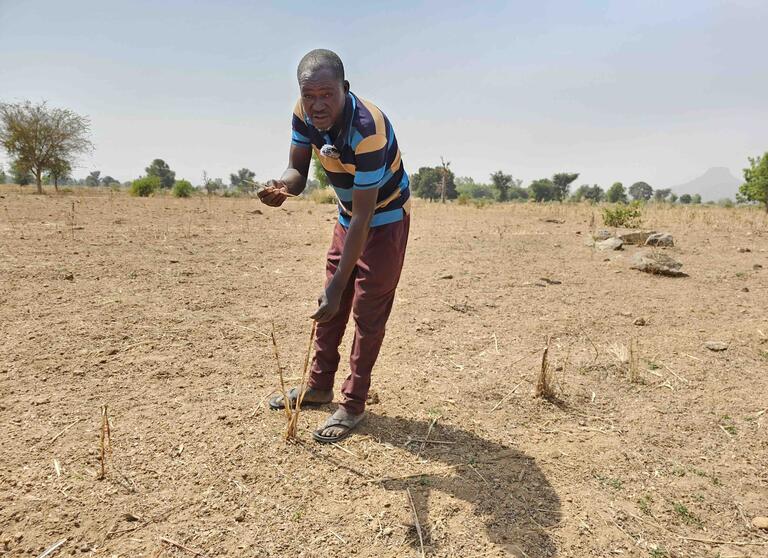
A farmer in the Mayo-Danay Division, she made her living growing sorghum, maize, and beans. But two years ago, floods destroyed her fields. Since then, rainfall has become increasingly erratic, the land less fertile, and harvests no longer sufficient to support her family.
Like thousands of other households in Cameroon’s Far North Region, she found herself facing a harsh reality: reducing the number of meals, gradually selling off her belongings, or relying on relatives and neighbours to survive.
Fadimatou’s story is far from unique.
In 2026, nearly 2.9 million people in Cameroon are facing food insecurity. In the North, Far North, East, North-West, and South-West regions, the combined effects of climate shocks, conflict, and population displacement continue to undermine people's livelihoods.
To respond to this crisis, the Cameroon Red Cross Society, with the support of the International Federation of Red Cross and Red Crescent Societies (IFRC), is implementing a 9.6 million Swiss franc Emergency Appeal. To date, 1.6 million Swiss francs have been mobilized, enabling an integrated response that combines cash assistance, livelihood support, community-based food security initiatives, and malnutrition prevention.
When cash restores the power to choose
Why is cash assistance one of the first forms of support provided to families facing food insecurity?
The beauty of cash assistance is that it allows households to decide their own priorities—whether buying food, clothing, medicines, or meeting other essential needs. At the same time, it supports local markets by enabling traders to continue their businesses.
For Fadimatou, this assistance is much more than a financial transfer.
It means being able to reclaim her role as a mother, make her own decisions, and prepare her children's favourite meal.
But in Cameroon’s Far North Region, food insecurity does not always have the same cause. While some have lost crops to flooding, others have lost their fields and livestock to drought. Many others have come to the area because they had no choice — they were forced to flee by conflict and violence.
Forced to flee or die
More than a hundred kilometres from Dana, in Mokolo, Zidang reflects on her memories.
"That night, when violence erupted in my village, I had only a few moments to act ".
She gathered her children. Then those of her co-wife.
And she fled.
She did not know where they would spend the night. She only knew they had to leave.
Today, Zidang is living with a host family. Without a home, farmland to cultivate, or any source of income, she has relied for months on the support of her community to feed the children in her care.
The cash assistance she received from the Cameroon Red Cross has enabled her, for the first time in a long while, to buy the essential items her family needs herself. She will be able to purchase millet, vegetables, and sleeping mats so that her children can sleep more comfortably.
Her story is different from Fadimatou's.
Yet both share the same reality: families struggling every day against food insecurity.
A response that evolves with communities' needs
Food insecurity cannot be addressed through a single intervention. As families recover from crisis, their needs evolve: from meeting immediate food needs to rebuilding livelihoods and strengthening their ability to withstand future shocks.
The Cameroon Red Cross Society, with the support of the IFRC, has designed its CHF 9.6 million Emergency Appeal around three complementary phases that accompany communities along this journey.
First phase
Focuses on saving lives by enabling families to meet their most urgent needs through cash assistance. By giving households, the flexibility to decide what they need most, cash helps restore food security while supporting local markets.
Second phase
Focuses on restoring livelihoods. As immediate needs begin to stabilize, families receive support to resume agricultural activities, rebuild productive assets and gradually recover their sources of income.
Third phase
Looks beyond recovery by strengthening resilience. Its objective is to help communities better prepare for future climate shocks, economic pressures and other crises, reducing their vulnerability over the long term.
Every contribution counts
Fadimatou's and Zidang's stories show how tailored assistance can transform a family's daily life.
For Fadimatou, it means being able to fill her pantry once again. For Zidang, it represents a first step towards rebuilding her life after fleeing violence.
But behind their stories are thousands of other families facing the same hardships.
Thanks to the CHF 1.66 million already mobilized, the Cameroon Red Cross Society and the IFRC have been able to provide life-saving assistance to thousands of people while implementing solutions that strengthen communities' resilience over the long term.
However, the Emergency Appeal, which seeks CHF 9.6 million, still faces a funding gap of CHF 7.94 million. This shortfall limits the ability to extend assistance to the many households that continue to face food insecurity in Cameroon’s Far North Region.
Additional funding will enable cash assistance to reach more families and support more communities, helping them not only overcome the current crisis but also become better equipped to withstand future shocks.
 Built with Shorthand