
By the Red Cross Red Crescent Climate Centre
As the Global Platform for Disaster Risk Reduction (GPDRR) ended in Geneva on Friday, IFRC Secretary General Jagan Chapagain renewed his call for the urgent matching of investment in early warning with capacity to act.
It’s still the case that “one in three disasters strikes without a formal public warning”, he added on social media, citing new IFRC research: “No lives should be lost in a predictable disaster.”
Mr Chapagain added to its call to action to the platform issued earlier by pledging the IFRC would “continue its efforts as a partner in the [UN-led] Early Warnings for All initiative, which aims to ensure everyone on Earth is protected by early-warning systems by 2027. However, significant work is still required to reach this critical goal.”
The week-long session of the GPDRR – the eighth overall but the first since the mid-term review of progress on implementation of the Sendai Framework – concluded that “countries have made significant progress, but challenges remain,” the UN said.
The closing co-chairs’ summary said the “world faces a polycrisis with growing risk-complexity, shaped by climate change, rapid urbanization and weakened multilateralism [but] disaster risk reduction offers a solution to addressing overlapping crises.”
In the summary, host nation Switzerland called for accelerated implementation of Sendai and a bridging of the “financial gaps hindering disaster risk reduction by mobilizing diverse funding sources, including climate finance.”
The GPDRR’s eight-point Geneva Call for Disaster Risk Reduction, linked in the chairs’ summary, advocates “[i]ncreasing funding for disaster risk reduction … to generate benefits across the development, humanitarian and climate agendas.”
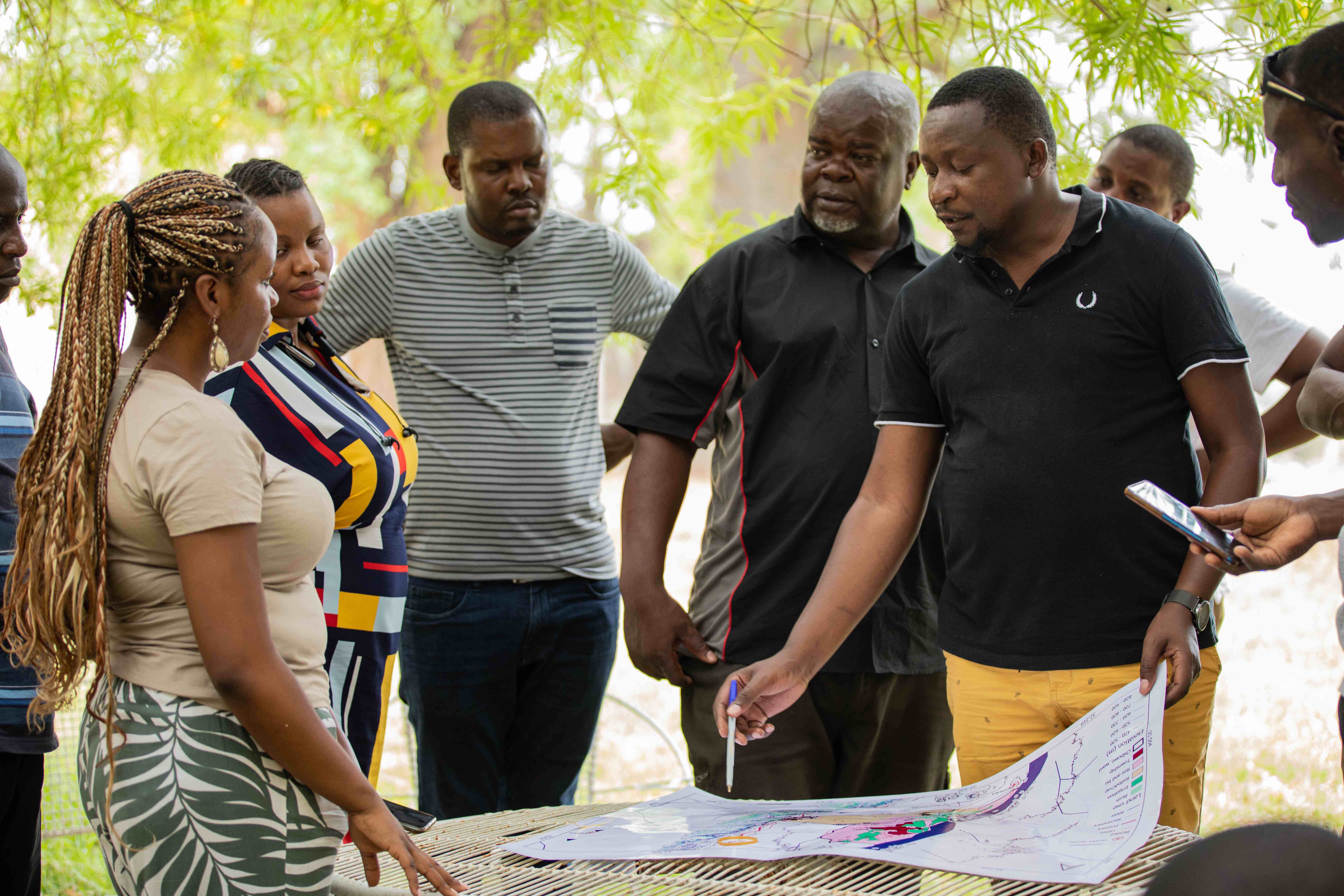
Leaders from the Zimbabwean village of Chibuwe meet the Government and Regional Anticipatory Action Working Group Secretariat — a collaboration led by the IFRC, the UN Food and Agricultural Organization, and the World Food Programme as they prepare the community's emergency flood-simulation exercise.
Photo: IFRC
‘One in three disasters strikes without a formal public warning’
Mr Chapagain also spoke at a GPDRR special event on extreme heat – an area of heightened concern this year – calling for a focus on what his called the “three P’s”: people, places and partnerships, stressing that local response was the best way to meet the growing heatwave threat.
He shared that platform with WMO Secretary-General Celeste Saulo and others at the session, which was intended contribute to the ongoing development of a common framework for the governance on extreme heat.
Among National Societies contributing to the GPDRR week, the Spanish Red Cross was among the speakers at a side-event organized by the IFRC and the American Red Cross on “leveraging locally led good practice for expanding nature-based solutionsfor disaster and climate risk”.
Guinbe Arnaud from the Chad Red Cross took an ignite stage session on work with mothers’ clubs there, and the Lebanese and Malawi Red Cross and the Somali Red Crescent were also represented.
The three days of the ignite stage included a tribute to the late Pablo Suarez from Bruno Haghebaert, a DRR specialist at Belgium’s Ghent University, who suggested ways his legacy could be continued for “creative risk communication”.
The IFRC’s research coordinator, Gefra Fulane, took an ignite session on its Community Trust Index; its Senior Officer for DRR, Blessed Mbang, took another on its road map for community resilience; and the Climate Centre’s Technical Adviser, Tesse de Boer, outlined opportunities for scaling up “multi-risk anticipatory action”.
Helen Gambon of the Swiss NGO DRR platform, hosted by the Red Cross, jointly organized a thematic session moderated by the IFRC’s Caroline Holt, its Director of Disaster, Climate and Crises, centring on the changes “required to governance structures, finance mechanisms, science, technology and partnerships to enhance disaster preparedness for resilient recovery”.
Jagan Chapagain’s other contributions included a special session on minimizing climate-related loss and damage and a thematic session on building resilience in complex settings.
‘A little bit of creativity goes a long way in sparking meaningful dialogue on DRR and adaptation’
The Climate Centre’s Catalina Jaime, who leads its work on climate and conflict, moderated a preparatory-days session on multi-hazard early warning systems in fragile, conflict- and violence-affected (FCV) settings; she also spoke at another session on localizing DRR.
She told delegates that this year’s GPDRR was seeing “increased attention to populations affected by the horrors of war and how their suffering increases vulnerabilities to disasters”.
Climate Centre Director Aditya Bahadur, who followed the GPDRR online, said today that in the round, “GPDRR represented a welcome shift toward under-addressed but critical areas: multi-hazard early warning, heat risk, locally led action, and risk reduction in FCV settings.
“Newly available Red Cross Red Crescent resources like the handbook for working in FCV areas or the toolkit for anticipatory action in them were referenced across plenaries and side events. It’s great to see these gaining traction – now it’s time to put them to use and drive lasting context-sensitive action.
“I was glad to see the IFRC-Climate Centre innovation booth became a real hotspot – organized and managed by our anticipatory action lead, Irene Amuron – proving again that a little bit of creativity goes a long way in sparking meaningful dialogue on the future of DRR and adaptation.”
Videos highlighting National Society work on risk reduction on show at the booth included community radio in Uganda, early warning in Bangladesh, Nepal, and worldwide, and anticipatory cash assistance in Nepal.
Recent articles about disaster risk reduction within the IFRC network:
Ready for the rains: Philippine Red Cross scales up emergency preparedness ahead of typhoon season
‘Now we know what to do’: Boosting local flood preparedness in Zimbabwe
Learn more about IFRC's approach to:
Disaster and crisis preparedness
Climate-smart disaster risk reduction