
Every year, millions of people face sudden emergencies — from road accidents to floods and heatwaves. As the climate crisis fuels more extreme weather, the ability to provide lifesaving First Aid has never been more critical.
In Lao PDR, where floods, landslides, and droughts are becoming more frequent, community members are often the first responders. First Aid training enables people to treat injuries, prevent complications, and stabilize lives until medical help arrives.
Since July 2025, for example, the Lao Red Cross (LRC) has been responding to widespread flooding triggered by Tropical Depression Wipha, which has affected more than 172,000 people across multiple provinces.
With support from the IFRC Disaster Response Emergency Fund (DREF), LRC branches have provided relief and essential services including First Aid for injured community members.
These recent emergency response interventions underscore how lifesaving First Aid skills are critical not only in daily life but also in the face of climate-driven disasters.
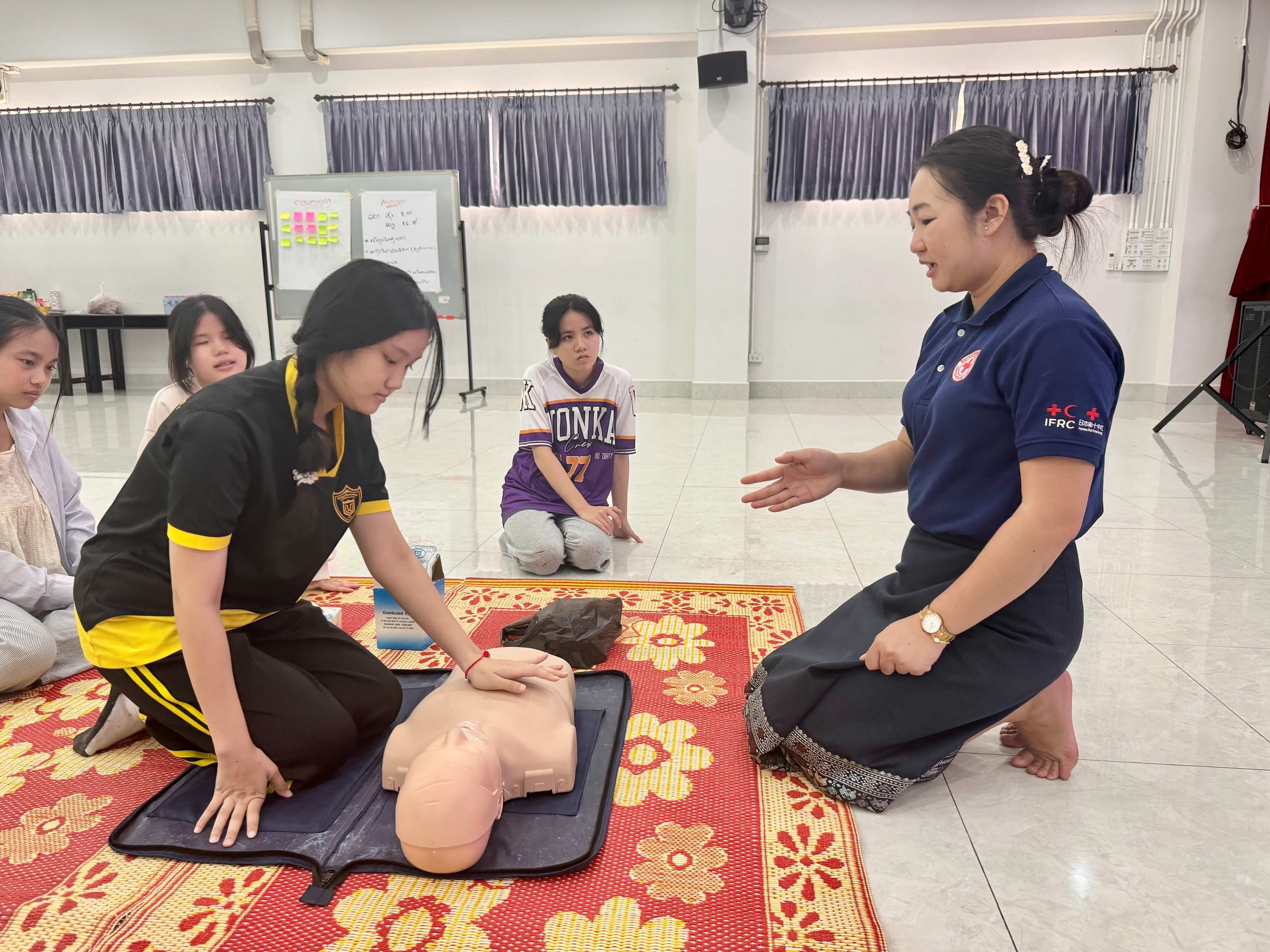
A first aid trainer from the Lao Red Cross shows students how to properly perform cardiopulmonary resuscitation (CPR).
Photo: Lao Red Cross
One of the most vital skills is Cardiopulmonary Resuscitation (CPR). Survival chances decrease by 10 per cent for every minute without CPR and defibrillation. These skills are especially crucial in remote areas, where access to health services is limited or delayed after disasters.
Red Cross first-aid trainers such as Kaithong Sesavath, who is also Deputy Head of the LRC Basic Health Department, bring these life-saving lessons regularly to schools and community gatherings.
“By bringing training into schools, LRC is empowering teachers and students with practical skills that save lives in both everyday accidents and climate-related emergencies,” says Kaithong. “CPR is especially important because it keeps blood and oxygen flowing when someone stops breathing or their heart stops.”
Backed by international solidarity
Support for this work comes from the Japanese Red Cross Society (JRCS) through the International Federation of Red Cross and Red Crescent Societies (IFRC). For the past six years, this support has allowed LRC to implement a comprehensive project aimed at “strengthening the capacity of Lao Red Cross staff on First Aid promotion for the public and communities”.
Since 2019, 76 staff from LRC Headquarters and provincial branches have been trained to become first aid trainers, and more than 2,500 teachers and students across 16 provinces have been trained in first aid.
The project is now at the end of Phase II, which focuses on six provinces (Oudomxay, Xiengkhouang, Bokeo, Champasak, Savannakhet, and Xaysomboun). During this phase, LRC also developed and launched training materials, including a first aid manual and guidelines tailored to the country’s specific needs, according to Dr. Soulany Chansy, Head of the LRC Emergency Health Division.
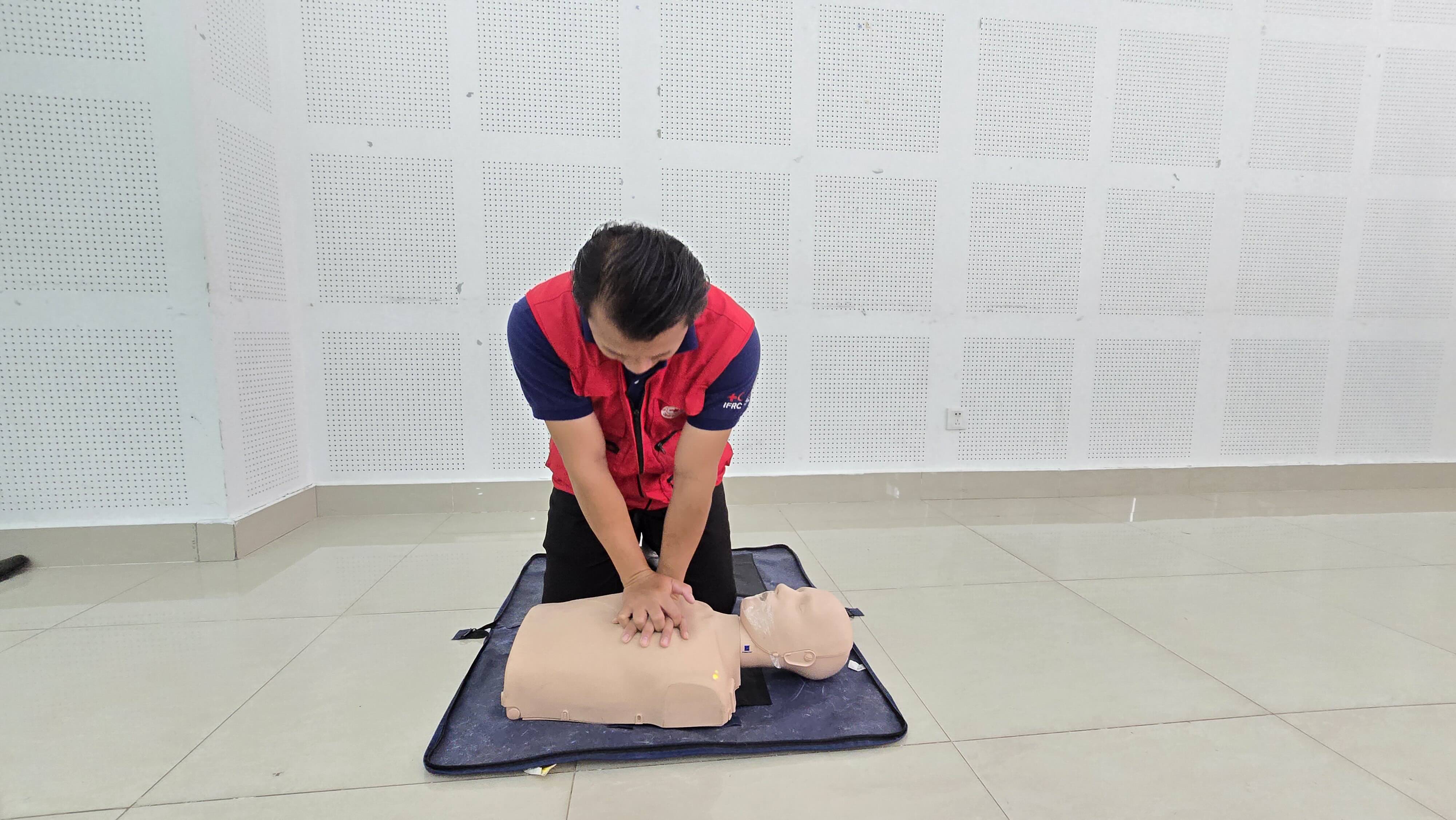
At a recent workshop, Kaithong Sesavath, First Aid trainer and Deputy Head of the LRC Basic Health Department, demonstrates the key steps of saving lives following a heart attack (calling for help, checking safety and responsiveness, performing chest compressions, and giving rescue breaths).
Photo: Lao Red Cross
Likewise, the trainings are adapted to meet the needs of local communities and integrated with local emergency response planning.
“Earlier this year, during a monitoring visit in Bokeo province, I saw how staff adapted training to local contexts and strengthened coordination,” added Aya Mizutani, IFRC Health Delegate. “Their practical demonstrations reflected not only knowledge gained but also motivation to improve First Aid delivery.”
The project also allows them to share knowledge and experience throughout the country. In July 2025, LRC hosted its First Aid Annual Meeting and Workshop in Vientiane. The two-day event gathered representatives from LRC headquarters and six provincial branches, IFRC, JRCS, and national ministries, to reflect on progress, share experiences, and plan for the next phase.
First aid for a safer future
The LRC experience shows that First Aid is more than an emergency response — it is a foundation for resilience. By equipping communities with lifesaving knowledge, First Aid is not only protecting lives today but also preparing Lao PDR to face the growing risks of climate change with strength and readiness.
This commitment reflects IFRC’s Strategy 2030, which aims to make First Aid accessible to everyone, everywhere. By embedding it into daily life, communities are ready not only for today’s accidents but also for tomorrow’s climate-driven emergencies.
By Kwanta Norkum, IFRC, Communications and Reporting Officer