United in Humanity.
No Matter Where,
No Matter When.
When crises and disasters strike...
They do not divide people into those who offer help and those who need it.
More often, they are the same people.
Across the world, Red Cross and Red Crescent volunteers and staff show up every day for people in crisis, responding in their own communities, helping neighbours, supporting families, and standing on the frontlines of emergencies that affect them too.
They are not separate from the people and communities they serve. They are part of them.
On World Red Cross and Red Crescent Day (8 May), we honour their commitment and celebrate their humanity. Because beyond every emergency, every response, and every emblem, there is one truth: we are united in humanity.
There when everything is lost
In Sudan, families cross borders with little more than what they can carry. Homes are left behind in haste. Livelihoods disappear overnight. Familiar places become unsafe, and the future becomes uncertain.
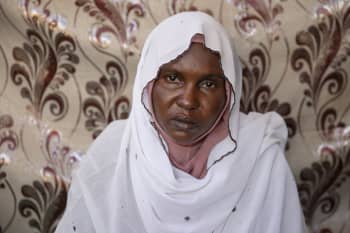
Across the border in eastern Chad, in Farchana refugee camp, Nawal Atteib Mahammad sits among other women beneath a shelter made of dried straw. She fled El Geneina in West Darfur when violence erupted in 2023.
Before the conflict, her life looked very different. She worked at the Ministry of Finance and had just begun her master’s studies.
“Now, I’ve lost everything: my home, my job, and my life.”
Her journey to safety was marked by violence.
“We saw bodies in the streets and families killed in their homes.”
Even after crossing the border, the challenges did not end. Many families continue to struggle to meet basic needs, facing insecurity and uncertainty every day.
And yet, they are not alone. Chad Red Cross volunteers, often from nearby communities, are there. They are helping provide access to clean water, basic services, and support that allows families to meet their most urgent needs. They bring dignity, and a sense that even in displacement, people are not forgotten.

Ariana García Díaz
Ariana García Díaz

There in the aftermath
Before the storm hit Cuba, Ariana García Díaz already faced a daily struggle.
“The water situation was truly critical,” she recalls. “We hadn’t had running water in the community for almost five months.”
Each day, she walked long distances just to fetch enough water to survive.
Then came Hurricane Melissa. In its wake, the destruction was immediate: homes were damaged, essential services were disrupted, and already difficult conditions became even worse. But the crisis did not end when the winds died down. Water became both a threat and a scarcity. Flooding increased the risk of disease, while access to clean water became an even greater daily burden, especially for women.
In the immediate aftermath of the hurricane, Cuban Red Cross volunteers were among the first to respond. They delivered clean water, worked to restore supply systems, and supported the hardest-hit families as recovery began.
Today, that support has brought a simple but essential relief.
"This water tank that you’ve set up for us is not just for this community, but for all the neighborhoods nearby. They’ve all come here to fill up on water."
In moments like these, recovery is not only about rebuilding what was lost, but about easing daily burdens and standing with communities as they move forward, together, united in humanity.
There in the midst of conflict
As hostilities escalated in the Middle East, civilians faced growing uncertainty and loss.
Iranian Red Crescent teams worked across affected areas, searching through rubble, rescuing survivors from collapsed buildings, and providing urgent medical care.
The risks were real. Ambulances and emergency centres were damaged. Volunteers were killed while carrying out their duties. Many responders were not only witnessing tragedy; they were living it.
At the same time in Israel, Magen David Adom teams responded to missile strikes, treating the injured, transporting patients to hospitals, and helping move vulnerable people to safer locations.
“We just looked for how we could help, find someone who needs help and take them to the hospital,” recalls one volunteer responder.
In both contexts, responders faced the same reality. They worked under danger, made life-saving decisions in seconds, and supported communities through moments of fear and loss.
There, day after day
The ongoing conflict between Russia and Ukraine has profoundly disrupted millions of lives and cast a shadow of uncertainty over the region.
In Ukraine, millions endured one of the harshest winters in recent memory. With energy systems repeatedly damaged, homes were left without heating or reliable electricity.
During blackouts, even the simplest things became difficult. People struggled to cook, stay warm, or call for help.
“In our apartment it is only eight degrees. When there is water, it is freezing cold,” say Tania and Yaroslav.
Across the country, Ukrainian Red Cross volunteers opened heating points where people could warm up, eat, charge their phones, and find a moment of relief from the cold.
For many, these spaces became a place to pause, connect, and regain a sense of normalcy.
“Thank you for not forgetting about people like us, who went through hell and survived,” says Tetyana.

Yaroslav and Tania
Yaroslav and Tania


Tetyana and her grandson Matuey
Tetyana and her grandson Matuey
There through it all
In the Philippines, communities faced not one disaster, but many. Within weeks, communities had to face an earthquake, followed by several devastating typhoons.
For volunteers, the crisis was deeply personal.
Homes were destroyed. Families were separated. And still, they continued to respond, rescuing others, providing care and support to their communities.
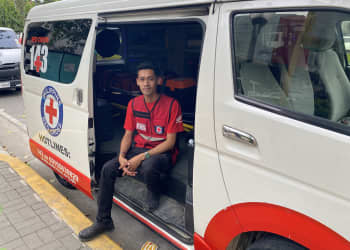
Christian Rosal had been volunteering for just a month when Typhoon Kalmaegi took his mother’s life and swept away his home.
“After Kalmaegi I had nothing left… I feel good that I’m helping others, but I’m hurting.”
Despite his loss, he continued to serve, driving an ambulance, supporting medical teams, and showing up each day.
Across the country, thousands of volunteers like him responded to the combined crises, helping neighbours, friends, and family members find safety and support.
They are not separate from the crisis.
They are living it.
And still, they show up.
Our common ground
In an increasingly complex and polarized world, where division and dehumanization are on the rise, humanity remains our common ground.
It is what connects people across borders, across crises, and across differences.
It is what turns compassion into action, into helping, healing, and standing with those who need it most.
Today, we also remember and pay tribute to those who have lost their lives in service of others. Their commitment is a powerful reminder of the need to safeguard humanitarian action and protect those who risk everything to assist others.
No matter where.
No matter when.
For more than 160 years, the International Red Cross and Red Crescent Movement has stood alongside communities in times of crisis, guided by the principles of neutrality, independence and impartiality, ensuring that aid reaches those most in need, wherever and whoever they are.
That commitment continues today.
Across Sudan, Cuba, Iran, Israel, Ukraine, the Philippines and far beyond, volunteers and staff continue to show up. They bring compassion, dignity and hope, and work to ensure that even in the darkest moments, humanity is never lost.
Because in the end, beyond every crisis and every response, we are, always, united in humanity.
 Built with Shorthand