
Santiago de Cuba/Panama/Geneva, 21 November 2025 - The International Federation of Red Cross and Red Crescent Societies (IFRC) has warned that the humanitarian needs of the population affected by Hurricane Melissa in eastern Cuba are growing faster than the international support required to provide short- and medium-term humanitarian assistance.
Three weeks after Melissa made landfall in Cuba, data from the Civil Defence and the United Nations System indicate that more than 2.2 million people were affected, mainly in the provinces of Santiago de Cuba, Granma and Holguín. In addition, the loss of more than 150,000 hectares of crops threatens food security, and damage to more than 155,000 homes exposes the population to the dengue, oropouche and chikungunya epidemics declared in the country. In addition, power cuts are limiting the operation of water plants and health services, especially in Santiago de Cuba, where 500,000 people still have no access to electricity.
"Countless families have lost everything: roofs, mattresses, food, animals, items that are essential for survival with well-being and dignity," said Carlos Pérez Díaz, executive president of the Cuban Red Cross. "From the very first minute, Cuban Red Cross teams have been travelling through the areas most affected by Melissa, distributing aid and offering psychosocial support, but our efforts fall short given the magnitude of the needs we encounter, especially in rural areas and in the coastal area where Melissa made landfall."
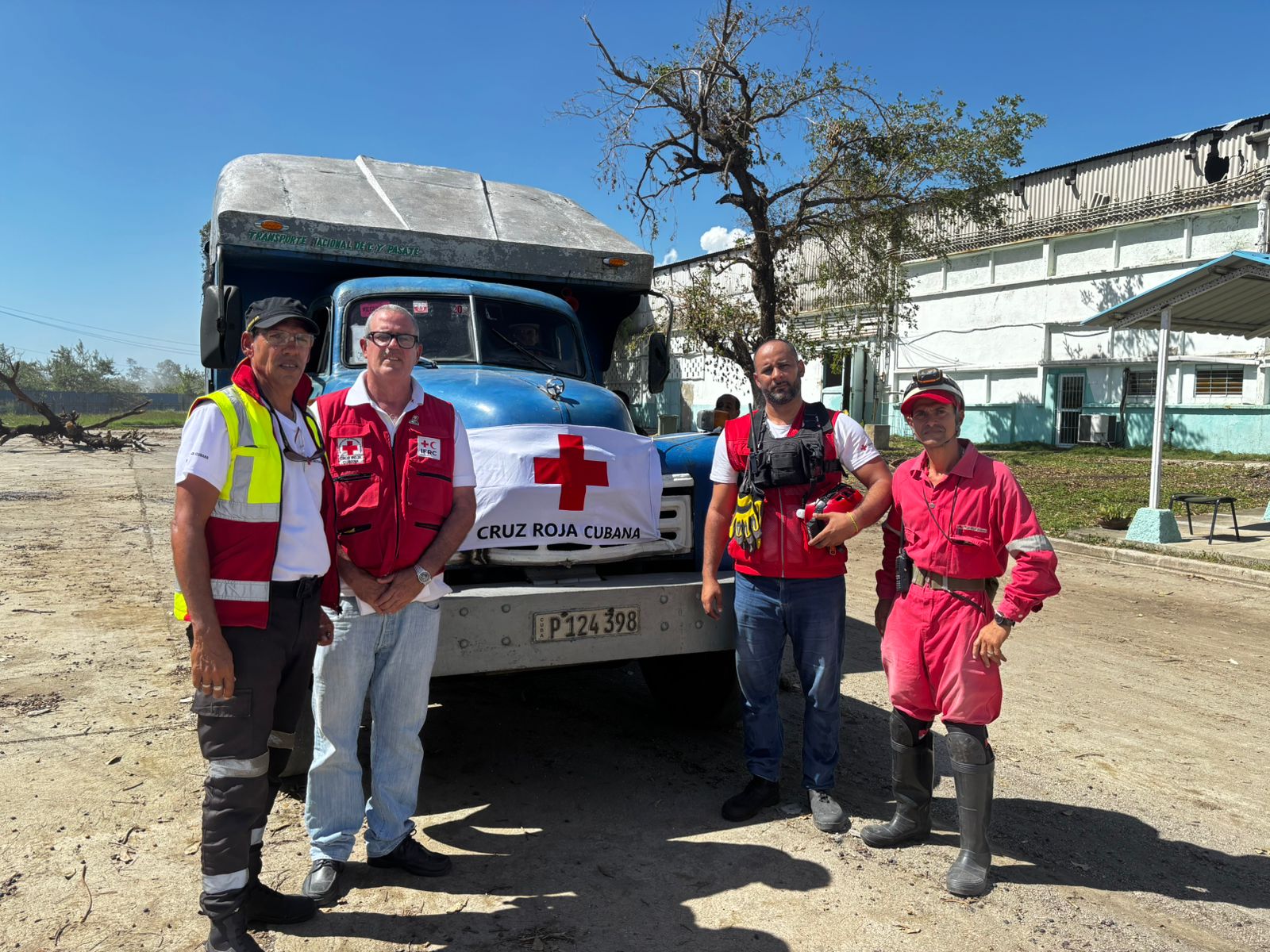
The Cuban Red Cross distributed relief items in Santiago de Cuba, following the devastation caused by Hurricane Melissa.
Photo: Cuban Red Cross
The first 20 tonnes of aid from the IFRC, which arrived in Cuba by air on 2 November, have already been distributed in full by Cuban Red Cross volunteers. This shipment included kitchen, hygiene and rest kits, blankets, mosquito nets, solar lamps, plastic sheeting and tool kits. These items were delivered to families whose homes were destroyed, elderly people living alone, people with disabilities, and pregnant women or women with children or dependents in their care.
"The pre-positioning of humanitarian supplies at our logistics hub in Panama allowed us to dispatch vital aid within the first 72 hours after Hurricane Melissa struck, and the organisational and coordination capacity of the Cuban Red Cross enabled us to distribute it in record time," said Cristian Torres Bermeo, IFRC Deputy Director for the Americas. "We have the experience, operational capacity and local presence necessary to reach the areas most in need, but we require more financial support to reach the thousands of families who still require urgent assistance and, as soon as conditions allow, to move on to the early recovery phase."
On 31 October, the IFRC launched an emergency appeal requesting 15 million Swiss francs (18 million USD) to provide two years of emergency assistance, early recovery and long-term resilience support to 100,000 people. Contributions received by the organisation amount to only 16.3% of the required amount, while needs on the island continue to rise.
The IFRC's international appeal will remain open for the next 24 months. Governments, businesses, foundations and even individuals can contribute resources that will enable communities to rebuild their homes, protect themselves from mosquito-borne diseases, take care of their mental health, resume productive activities, rely on solar energy to cope with power cuts and prepare for the next hurricane season.
The IFRC has a strong track record in implementing humanitarian operations in Cuba. Working hand in hand with the Cuban Red Cross – and its network of more than 35,000 volunteers – and in coordination with public authorities and national and international humanitarian actors, it has responded to dozens of hurricanes and storms, including Ian, Oscar, Rafael, Matthew, Irma and Sandy, always guided by its fundamental principles and with interventions based on needs assessments and dialogue with the affected communities.
For further information or interviews, please write to [email protected] or contact
In Santiago de Cuba
Susana Arroyo Barrantes, +507 69993199
In Panama
María Victoria Langman, +507 65501090
In Geneva
Nora Peter +36 70 953 7709


