
Local volunteers and new energy sources power the Cuban Red Cross’s response to Hurricane Melissa six months after the storm
Two active operations, a reinforced strategy, and 39,000 active volunteers across the island. This is how the Cuban Red Cross and the IFRC are tackling recovery efforts following Hurricane Melissa, with fuel and energy shortages impacting every aspect of daily life in the country.
Distribution of humanitarian aid in Granma. © Cuban Red Cross
Distribution of humanitarian aid in Granma. © Cuban Red Cross
On 15 April, Cuban Red Cross volunteers distributed mosquito nets, cleaning supplies and other essential items to help prevent chikungunya and dengue in the La Antena community in Matanzas province.
This was the first distribution of a humanitarian operation funded by the Disaster Response Emergency Fund (IFRC-DREF), which aims to assist 650 families affected by the arbovirus epidemic in western Cuba.
As of January 5, 55 deaths associated with arboviral diseases were reported: 37 due to chikungunya and 18 due to dengue. The majority of those who died were under 18 years of age.
"The hurricane has left behind many epidemics and insects, mainly mosquitoes and sand flies, which don't let you rest day or night — you can barely sleep", told Berta González, a local fisherwoman whose home was reduced to rubble.
"Many people are sick. I know people whose legs have been badly affected. They can’t move their hands or walk, and they lose their sense of taste and smell."
A week later, on 21 April, local Red Cross teams launched a new humanitarian aid distribution in Cauto Cristo, Granma province — one of the areas worst affected by Hurricane Melissa in October 2025, and a priority zone in the emergency appeal launched by the International Federation in response to the storm's damage.
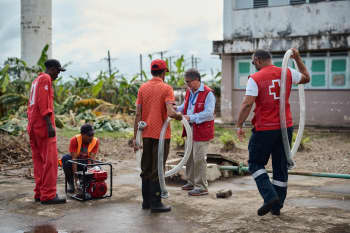
Distribution of clean water in Granma. © Cuban Red Cross
Distribution of clean water in Granma. © Cuban Red Cross
These deliveries are taking place in challenging circumstances: energy restrictions on the island are threatening the provision of essential services, worsening sanitation conditions and hindering the continuity of humanitarian operations.
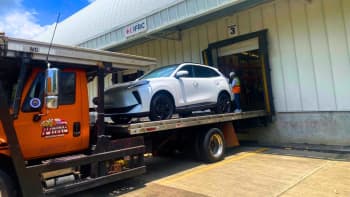
The Cuban Red Cross and the IFRC have managed to maintain their services by ensuring regular access to fuel, as well as by shipping electric vehicles and photovoltaic systems to Havana, thereby strengthening the logistical and operational capacity of the national headquarters and branches across the country. The challenge now is to sustain operations, prevent setbacks in communities that are already making progress in their recovery, and prepare for a new hurricane season amid adversity.
Hurricane Melissa: Let the recovery continue
On 20 October 2025, Hurricane Melissa left more than two million people displaced as it swept through Cuba, particularly affecting the eastern provinces of Santiago de Cuba, Granma and Holguín.
The storm destroyed hundreds of thousands of homes, damaged over 700 healthcare facilities and severely disrupted water systems, halting operations at around 100 pumping stations. Entire communities were left without reliable access to electricity, drinking water or basic services.
Forty-eight hours after Melissa passed, the IFRC launched an emergency appeal to raise 18 million Swiss francs (USD 23 million). The aim was to strengthen the Cuban Red Cross’s initial response and support the recovery of 100,000 people over 24 months.
Since then, more than 5,000 people have received humanitarian assistance in the form of mosquito nets, blankets, hygiene supplies, cooking supplies, cleaning supplies, solar lamps, tarpaulins, and tools to rebuild their homes. Another 2,600 people have received psychosocial support to help them cope with grief and anxiety following the disaster.
Today, the water systems installed by Cuban Red Cross volunteers in the wake of Hurricane Melissa continue to produce millions of litres of drinking water, meeting the basic daily needs of up to 30,000 people per week.
However, the recovery process could slow down. Limited access to fuel, prolonged power outages and instability in the electrical grid continue to affect transportation, customs, health services, waste management and water pumping.
“The IFRC and the Cuban Red Cross have decades of experience responding to hurricanes in the country, including Ian, Sandy, Matthew and Irma, but few operations have been as logistically complex as this one,” says Cristian Torres, IFRC Deputy Director for the Americas.
“The need to address energy, health and transport challenges is clear, as is the dedication of Red Cross volunteers and technical teams. In coordination with public institutions and key humanitarian actors, they are active in the eastern part of the country and across the island, distributing assistance as it becomes available.”
A reinforced strategy to adapt and sustain assistance
To ensure that aid reaches the island and that the minimum functionality of essential public services is maintained — even during prolonged power outages or periods of acute fuel shortages — the IFRC and the Cuban Red Cross have launched a reinforced strategy under the emergency appeal.
This strategy has four pillars:
- installing decentralised photovoltaic systems to ensure a reliable power supply at locations where humanitarian assistance and essential services cannot be interrupted;
- implementing electric transportation;
- deploying special Red Cross brigades to assist with solid waste;
- ensuring that Cuban Red Cross has access to fuel to provide humanitarian assistance to the population.
The Cuban Red Cross is already installing 14 battery charging systems provided by the IFRC, to ensure a reliable electricity supply and prevent communications and logistics from coming to a halt during blackouts.
To support mobility and field operations, the IFRC has shipped an electric vehicle and eight motorcycles.
In addition, the Cuban Red Cross and the IFRC have secured fuel through agreements with local suppliers to keep the vehicle fleet operational.
To continue supporting the population, 500 roof repair kits are being produced to help repair homes damaged by Melissa.
"For three months, we faced operational difficulties because fuel wasn’t entering the country," explained Dr Carlos Pérez Díaz, Secretary General of the Cuban Red Cross, following the distributions in Matanzas.
"But we’ve now regained that resource and are resuming the delivery of donations and humanitarian aid directly in the communities."
Without sufficient funding, progress is at risk
Continuing recovery efforts and preparing for new emergencies requires strengthening local action and securing sustained international support.
While the Cuban Red Cross relies on the commitment of 39,000 volunteers across the island, securing the full funding required to assist the 100,000 people covered by the IFRC’s emergency appeal is essential.
Of the 18 million Swiss francs requested, only 28 per cent has been raised. A new influx of resources is urgently needed, particularly to implement solutions such as electric garbage trucks for waste management.
With the upcoming hurricane season approaching, international support would also help to strengthen institutional and community resilience. The IFRC is calling for a united effort to ensure that essential services remain accessible and that recovery can proceed with dignity and certainty.
 Built with Shorthand

