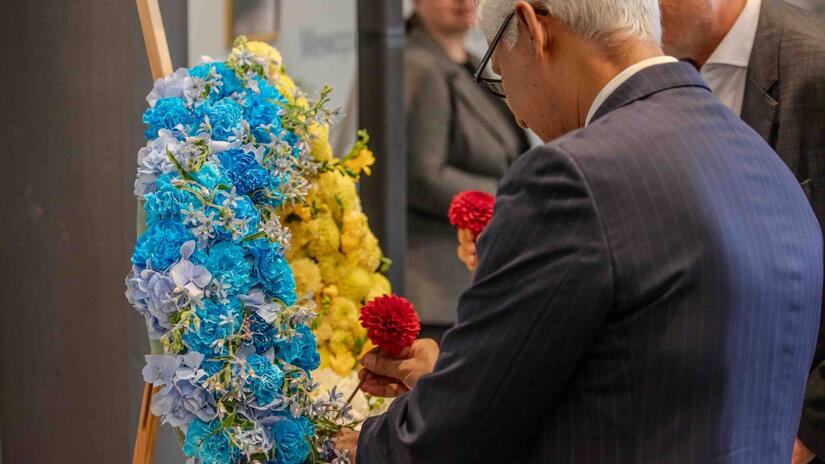
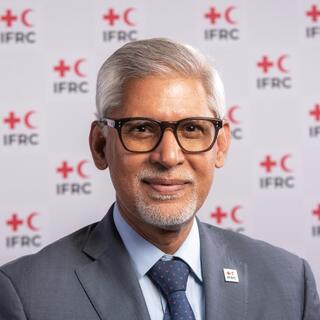
On World Humanitarian Day (August 19, 2025) I had the solemn duty of reflecting on the rising attacks against our staff and volunteers, and calling for stronger protection of humanitarian workers. The event was hosted by the IFRC with the support of the Australian mission in Geneva.
At the IFRC, we’re proud to support the Declaration for the Protection of Humanitarian Personnel – an Australian Government initiative which will set out practical and actionable steps to protect humanitarian workers. I was delighted to hear that the Declaration is nearing finalization. States will be invited to commit to driving real, practical action to protect humanitarian workers very soon.
Below is the is the speech I gave during the event:
"Until four days ago, Honelegn Fentahun was one of our best. Dedicated to the collective mission of the Red Cross, Red Crescent family. Honoring our Fundamental Principles. Local to his community. Committed to it. He was part of the Ethiopian Red Cross Society's North Gondar team.
But, on 14 August, as Honelegn and two colleagues were returning from delivering an ambulance to Janamora district – their vehicle was intercepted, and they were kidnapped by armed men. The three were released the next day, without their vehicle. But Honelegn’s health had been gravely affected. He died on August 15. Awful. And – tragically – just the latest.
This year our National Societies have lost EIGHTEEN people while on duty. Honelegn’s death is not an exception — it is part of a worrying trend.
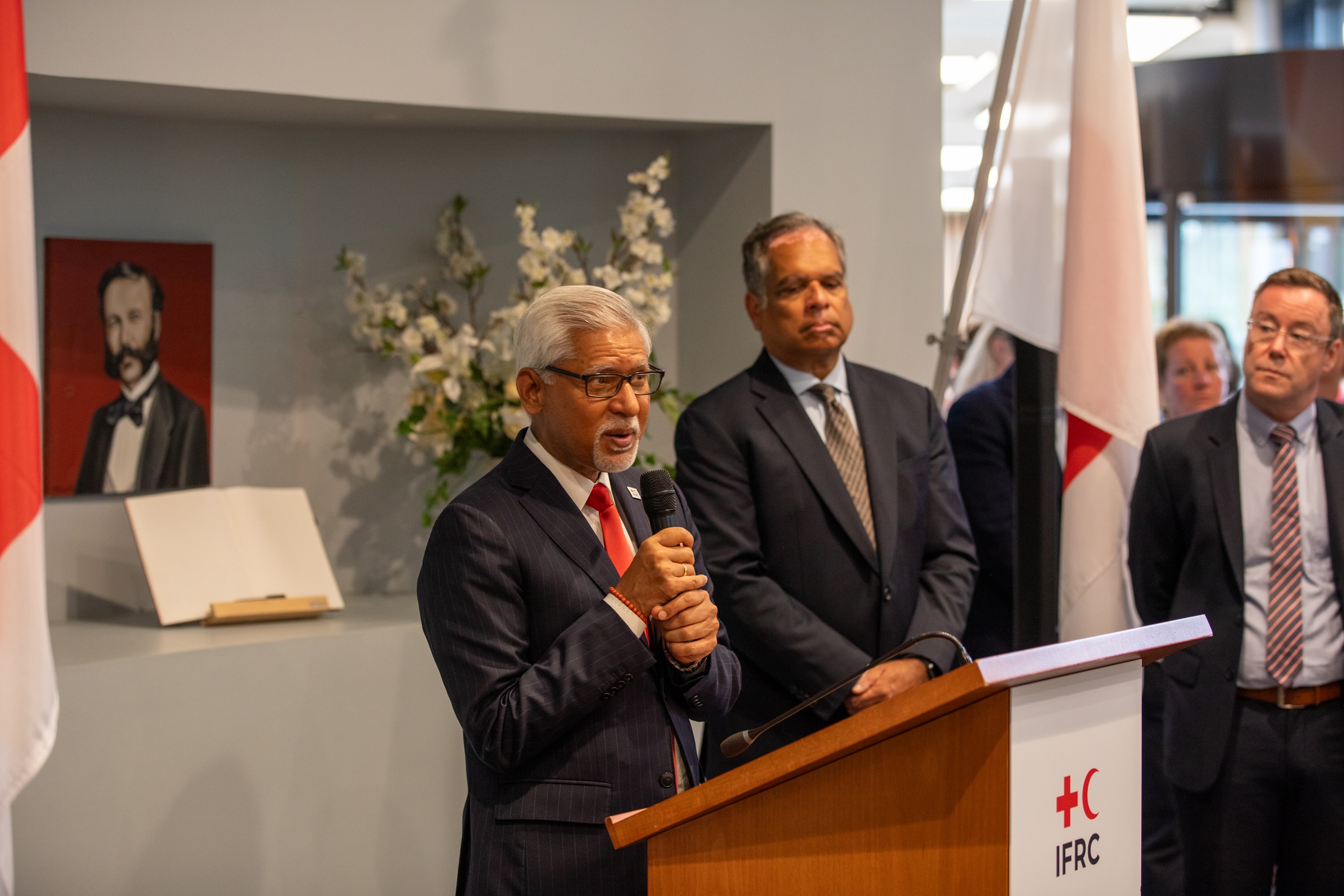
IFRC Secretary General Jagan Chapagain speaking on World Humanitarian Day during a ceremony honouring humanitarians killed in the line of duty.
Photo: IFRC
Take another – more horrific still. Rifatt Radwan was 23-years-old; a volunteer with the Palestinian Red Crescent (PRCS). A dedicated humanitarian, serving his community.
With whatever he could earn, he supported his ill father and dreamt of continuing his studies. But before he could fulfill those dreams, Rifat was killed on duty alongside SEVEN fellow PRCS ambulance staff, in Tel-Al-Sultan, Rafah. Their bodies were found buried in the sand, still wearing their red vests.
Rifat and Honelegn’s stories are among many. Far too many.
In 2025 alone, the PRCS has lost 9 colleagues on duty. Since October 7, 2023, 31 colleagues from the PRCS have died. Magen David Adom – our National Society in Israel - has lost 6 colleagues since the same date.
In 2024 overall, 32 volunteers and staff of National Red Cross Red Crescent Societies lost their lives. And I repeat - already 18 colleagues from our members have been killed on duty this year. All local. All working to save lives in their communities.
I’ve visited lots of National Societies this year, from Syria to Somalia, Botswana, the Democratic Republic of Congo, South Africa and Lesotho - and one thing keeps standing out. While, with funding cuts particularly, many international organizations are leaving, National Red Crescent and Red Cross staff and volunteers remain. They are often the only ones on the ground.
They do the work so necessary and yet so often overlooked. It’s vital. We must protect it. We must protect THEM. In the last few years, our volunteers have become targets. The Red Cross and Red Crescent emblems on their vests and helmets – which should be shields – are ignored.
That’s why we back – 100 per cent - the forthcoming Declaration for the Protection of Humanitarian Personnel to protect humanitarian workers. This declaration is a big step forward in protecting those who protect others . . . particularly LOCAL workers, committed to the communities in which they live and work. And I applaud the leadership of Australia in this regard.
At the IFRC, we do not start and stop at condolences. We stand up to protect those we can. This is the work we've been doing for some time. This year, and especially today, we are pushing for our #ProtectHumanity exhibit with the names and photos of colleagues lost in the course of their work.
We must and do mourn but today is also about looking forward - committing to action that puts an end to violence against humanitarian workers. So, here’s what we are doing.
First: supporting families. Last year at our General Assembly we launched the 'Red Family Fund’ to support families of those killed on duty. The fund is a sign of solidarity, to show families they are not alone. We welcome the efforts of United Nations Office for the Coordination of Humanitarian Affairs (OCHA) to promote the Red Family Fund as part of their World Humanitarian Day campaign. If you’d like to contribute anything – big or small – donations can be made through this link.
Second, we must raise awareness. We want the world to know the names and if possible, the stories of those we have lost. That’s why I started with two today. We urge people to use their voices to say humanitarians are NOT a target, to raise awareness in their own networks and communities . . . and to urge leaders to uphold their obligations under international law.
Finally, we must seek action. And that is why the Declaration that Clare mentioned, and we’re committed to, is so vital.
As part of its ongoing commitment, the IFRC is collecting messages of solidarity and condolences in two dedicated books: one for the families and colleagues of those who have died, and another to express support, empathy, and unity with staff and volunteers. These messages will be shared on International Volunteer Day, December 5, as a gesture of appreciation for the extraordinary dedication of humanitarian workers worldwide.
The protection of those who are the frontlines of crises is not optional – it is essential. Their work is vital, yet their safety increasingly fragile. The international community must act decisively and ensure that humanitarian workers are never again treated as targets. The deaths must – I repeat MUST – stop."