

A powerful earthquake, measuring 7.7 magnitude on the Richter Scale, hit central Myanmar at 1:10 pm local time on 28 March, causing widespread damage to homes, collapsing buildings and infrastructure. The epicenter of the quake was about 17 kilometers from Mandalay, the country’s second-largest city.
Emergency response teams from the Myanmar Red Cross were immediately deployed to provide urgent care for people injured or looking for missing loved ones. Teams continue to assess the impact on people caught up in the quake.
A strong 6.4 magnitude aftershock, just 12 minutes later, intensified the devastation, further damaging structures in Mandalay and Sagaing, complicating rescue efforts, and raising fears of more casualties.
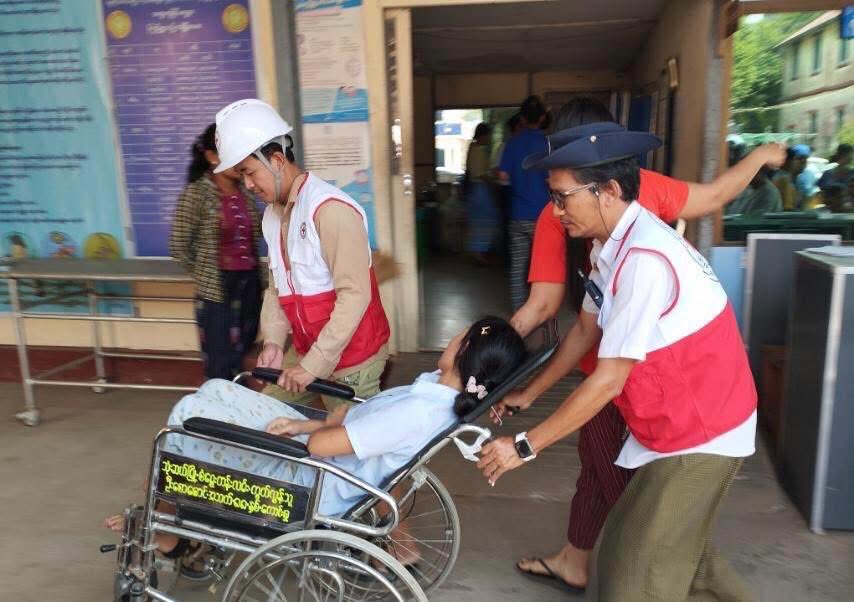
Myanmar Red Cross personnel transport earthquake survivor to medical facility for urgent care.
Photo: Myanmar Red Cross Society
Full extent of damage unclear
The full extent of the destruction and official casualty figures remain unclear, however significant damage to key infrascruture has been confirmed:
• The Sagaing automobile bridge that serves as the main connector to Mandalay has collapsed, further complicating emergency response.
• Mandalay Airport is reported to have been affected, but the extent of damage is not yet clear.
• Mandalay University and the Mandalay palace ancient wall have collapsed.
• The Myanmar Red Cross Society Nay Pyi Taw headquarters building and the Mandalay Emergency Operations Centre have been damaged.
• Tele-communications have been cut off in Mandalay, Sagaing and Southern Shan State causing the blockage of internet and unstable phone connectivity.
Watch this video update from Marie Manrique, acting IFRC Head of Delegation in Myanmar:
To scale up support, the IFRC launched an Emergency Appeal for 100 million CHF to assist 100,000 people (20,000 households) with life-saving relief and early recovery support over the next 24 months. Two million CHF were released through the IFRC’s Disaster Response Emergency Fund (IFRC-DREF) to support the operation immediately.
The earthquake’s impact extended beyond Myanmar’s borders.
In Bangkok, Thailand—nearly 800 kilometers away—the tremors triggered mass evacuations of high-rise buildings. The aftershock contributed to further instability, and a partially constructed skyscraper in the Chatuchak district collapsed, though the number of workers inside remains unknown.
Metro and light rail services were temporarily suspended as a safety precaution. The tremors were also felt across several countries, leading to evacuations and widespread panic.
The Thai Prime Minister declared a state of emergency in Bangkok, urging residents to evacuate tall buildings due to the risk of aftershocks. Authorities are assessing infrastructure safety, and flight operations at Suvarnabhumi Airport are expected to face delays in the coming days.


