
“We're drawing on our inner strength to keep providing support”
Inside the Red Cross response to Venezuela's earthquakes, told by the volunteers who keep working through their own grief.
On the evening of 24 June 2026, the earth moved beneath Venezuela, twice.
A 7.2 foreshock hit first. Seconds later came a 7.5 mainshock, one of the strongest earthquakes to strike the country in more than a century. There have been hundreds of aftershocks since then, including a significant one on 29 June.
By morning and during the following days, the scale of the loss was staggering. As of July 3, official authorities have reported a total of 2,645 deaths and 12,666 people injured, entire neighbourhoods reduced to rubble.
In La Guaira and across Gran Caracas, apartment blocks collapsed onto the streets. Roads split open. Power, water and phone lines went dark.
Venezuela declared a state of emergency, suspended schools, and launched search-and-rescue operations, but with hospitals damaged and the main international airport closed, even reaching survivors became a battle.
Now, families are sleeping in public squares and sports fields, not by choice, but because they're too afraid to go home, or because there's no home left. Many are still waiting for news of loved ones buried under the rubble.
First on the scene
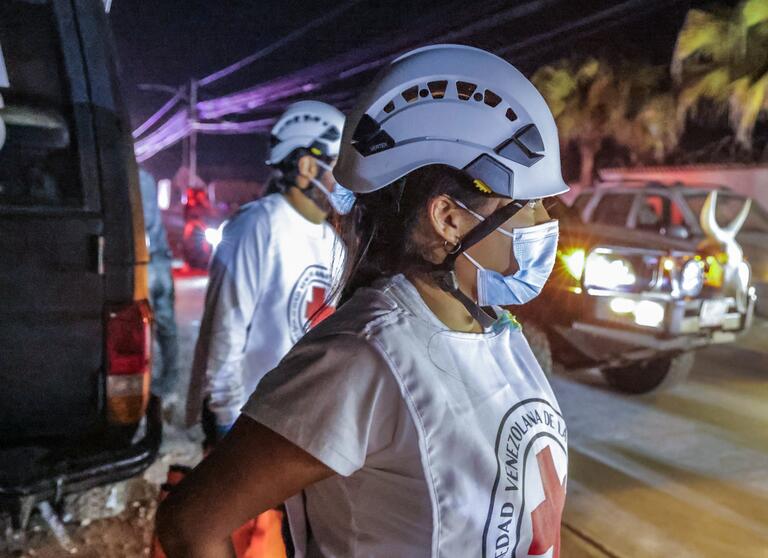
Within hours of the first tremor, Venezuelan Red Cross (VRC) volunteers were already on the ground, many of them in neighbourhoods where they themselves live.
They've since been joined by colleagues from across the country, IFRC staff, and Red Cross teams from around the world, all confronting a wave of injuries that hasn't let up.
Luis Lamus, an internist at the Venezuelan Red Cross field hospital in La Guaira, was treating the injured since the first hours after the quake.
"The conditions we've seen at the medical post and during street outreach have been patients with head trauma, chest trauma, crush injuries, compartment syndromes, and dehydration. There have also been respiratory problems from inhaling debris, which is becoming more of an issue for the families desperately searching for their loved ones."
Luis Lamus
Luis Lamus
Volunteers have set up medical posts in shelters, given emotional support after the shock, and worked to reconnect families torn apart in the chaos, all while grappling with disrupted supply lines, damaged facilities, and a need that keeps growing.
In La Guaira, the VRC has set up a field hospital and first-aid stations to relieve pressure on overwhelmed local health facilities.
Red Cross and Red Crescent teams across from Costa Rica, Colombia, México, Panamá, Aruba, Germany, Spain, Norway, Türkiye and Qatar have stepped in too, supporting medical care, activating Restoring Family Links services, and joining search-and-rescue efforts on the ground, including specialist units with dogs trained to locate survivors trapped beneath the rubble.
A rescue that inspired the world
Saving lives has been the driving force and mission of the Red Cross since its inception.
After four days of tireless and compassionate work, on Thursday, 2 July, a survivor was successfully rescued.
Red Cross rescuers and Urban Search and Rescue (USAR) teams from seven countries combined their knowledge, tools, equipment, and efforts to rescue a security guard who was trapped under the rubble.
This was a difficult operation — for many rescuers, the most complex of their careers. It required specialized knowledge, experience, technical rigor, responsibility and ethics.
But this rescue wasn't just about a single man. Waiting nearby were his family and loved ones, who, in addition to experiencing the disaster firsthand, suffered agonizingly as the hours passed. Red Cross teams were there to support them throughout the wait.
This inspiring rescue demonstrated, once again, that when compassion, experience, and preparedness go hand in hand, we can better care for one another and overcome the most complex challenges.


Working through exhaustion and distress
The physical demands of the response have been relentless, pushing both survivors and rescuers toward dehydration and exhaustion.
But it's not just the body that's being tested.
"The volunteers have been facing frustration, at not being able to do more, because people are overwhelmed and we're not able to help everyone. It's something that exhausts us. There are emotions, there's stress. We may have family members or friends who are trapped, but we're drawing on our inner strength to keep providing support, so we can get through this."
"There aren't any words that’ll help them understand what happened."
Antonio Ferreira, a volunteer orthopedic surgeon with 21 years at the Venezuelan Red Cross, has spent his shifts treating a steady stream of patients since the quake. For him, it's not the physical injuries that weigh heaviest, it's what patients carry with them.
"It's the psychological impact. When you listen to the patients, and see everything they've lost, there aren't any words you can use that’ll help them understand what happened."
Most of his patients are children and older adults, the people least able to escape in time.
Antonio Ferreira
Antonio Ferreira
The firefighter who couldn't save his own
Of everything Antonio has seen, one story has stayed with him.
A firefighter was brought in for treatment, injured while pulling other people from the wreckage. As Antonio worked on his ankle, the man began to talk, about the people he'd rescued, and about the one he hadn't been able to.
"Even though he's a relief worker, knowing how to respond, how to evacuate, he couldn't apply that to his own flesh and blood. He hadn't been able to save his own family member."
“It's hard to wrap your head around, because it could happen to any of us, to us as healthcare workers, knowing you have all the tools to help them, but still couldn't."
The IFRC mobilises
Within hours, the IFRC released 2 million Swiss francs from its Disaster Response Emergency Fund (IFRC-DREF) for immediate relief. Forty-eight hours later, it launched a 50-million-Swiss-franc emergency appeal to reach 300,000 people in the hardest-hit areas during the next two years, covering health care, clean water, shelter, cash assistance and psychosocial support.
The first shipments of aid have already arrived: relief supplies, including tarpaulins, mosquito nets, hygiene kits, water filters, blankets, solar lamps and folding beds, the essentials for families who have lost everything.
But the need is far from met, says Nelson Aly Rodríguez, IFRC's head of delegation in Venezuela.
"Experience tells us it will be necessary to have sufficient resources to meet the needs of a very large population that currently has no home and no shelter. We believe IFRC's emergency appeal will help us achieve an effective, robust response, coordinated through the Venezuelan Red Cross."
"There are volunteers here today who have lost family members and loved ones, and yet they have decided to continue. I believe this is the clearest demonstration of our people's conviction, that they can step up when a vulnerable population is crying out for support."
Nelson Aly Rodríguez
Nelson Aly Rodríguez
You can help
Amid everything Venezuela has lost, its volunteers haven't stopped. Robert Díaz, a nurse and first responder who joined the response on the second day of the disaster, put it simply.
"Distance is no barrier to our ability to act. We're driven by a calling to serve and a deep love for what we do."
The Venezuelan Red Cross teams are at the heart of this response, but they can't do it alone.
Every contribution helps deliver clean water, shelter, medical care and hope to families who have lost everything.
Photo and video credit: Susana Arroyo/IFRC, Venezuelan Red Cross, Costa Rican Red Cross
 Built with Shorthand