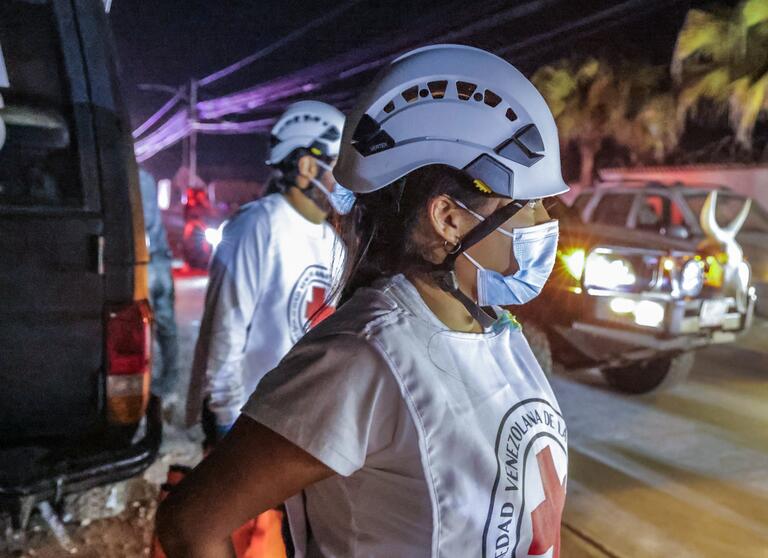
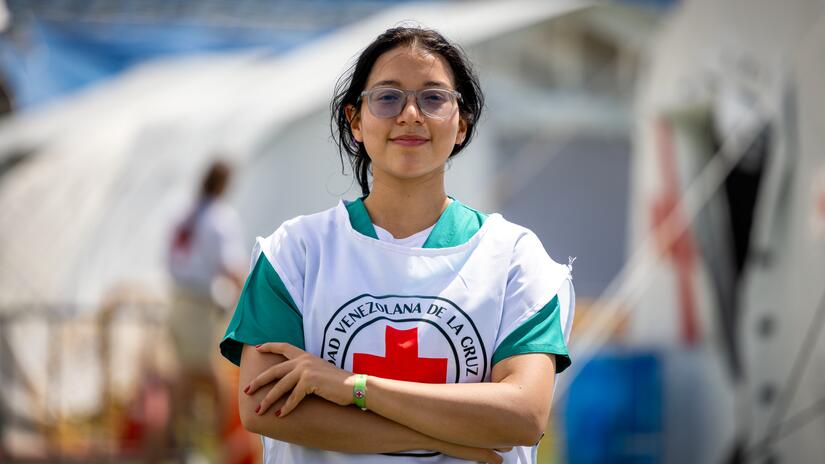
Eight years after joining the Venezuelan Red Cross as a nursing student, Albani found a coincidence that she cannot forget: the date on which the International Red Cross and Red Crescent Movement was founded is the same date that her country needed its help.
Albani Rojas has been a volunteer with the Venezuelan Red Cross for eight years. Like so many stories within the Movement, hers began by chance: she was studying nursing when she saw an invitation to a first-aid course organised by the Red Cross and the College of Nursing.
"I was interested in it; I thought I could combine this new career with that work," she recalls. She enrolled as a trainee in the emergency response department, training for two years. Later, life took her down other paths within the organisation, but she never strayed entirely from it, continuing to volunteer in various areas. She says this is where she discovered her passion for nursing and service.
Throughout her career, during training sessions and outreach events, Albani repeatedly heard about the seven Fundamental Principles, the birth of the Movement, and the importance of providing impartial, neutral and independent humanitarian assistance. But this year, those teachings ceased to be mere theory: "I experienced them firsthand."
A recurring date:
On 24 June 1859, the Franco-Sardinian and Austrian armies clashed on the fields of Solferino in northern Italy in one of the bloodiest battles of the era. That same afternoon, a Swiss businessman named Henry Dunant arrived on the battlefield, hoping to meet Napoleon III. Instead, he found thousands of wounded soldiers left to fend for themselves. Horrified by what he saw, he organised the local population, especially women and girls from nearby Castiglione delle Stiviere, to provide equal aid to all, regardless of their uniform.
The slogan they coined went down in history: "Tutti fratelli" — we are all brothers and sisters. Four years later, this experience would give rise to the world’s largest humanitarian network.
Rojas had heard this story for years, and on 24 June 2026, two earthquakes measuring 7.2 and 7.5 on the Richter scale struck Venezuela’s central coast just seconds apart.
The quakes were so powerful that they were felt as far away as Colombia, Trinidad and Tobago, Aruba, Curaçao and northern Brazil. The state of La Guaira was hit hardest, with entire neighbourhoods in Catia La Mar, Caraballeda, and Playa Grande reduced to rubble. This was the deadliest earthquake that Venezuela had experienced in over a century, far surpassing the 1967 Caracas earthquake.
Weeks later, as the search-and-rescue phase was coming to an end and the country was focused on recovery, the official death toll had surpassed 5,000, with 16,000 injured—figures that authorities warned could continue to rise.
"What a coincidence!" she thought when she realized that the date of the new disaster coincided with the founding of the organization she is now a part of—and through which she is supporting the recovery of thousands of affected people.
"Brother countries"
One of Albani’s earliest memories after the tragedy was the arrival of aid from "brother countries." Her memory serves her well. In the four weeks following the earthquake, rescue teams from more than thirty countries arrived in Venezuela, including the National Red Cross and Red Crescent Societies of Aruba, Colombia, Costa Rica, El Salvador, Germany, Greece, Italy, Mexico, Qatar, Spain, Switzerland, and Türkiye. And support was also felt from afar: sixteen National Societies launched campaigns in solidarity with the affected population.
Just hours after the earthquake, the International Federation of Red Cross and Red Crescent Societies (IFRC) disbursed two million Swiss francs from its Emergency Disaster Response Fund, launched an emergency appeal, and sent the first shipments of humanitarian aid from Panama.
For Rojas, the international response, with countries acting solely out of humanitarian concern, bears some resemblance to the scene staged by the women of Castiglione 167 years ago, albeit on a different scale.
"Obviously, it wasn't the way we'd want our brothers and sisters to get to know us," she reflects. However, that empathy has resonated with her every day since then, whenever she travels from Caracas to La Guaira and sees all that still needs to be rebuilt.
What Lies Ahead
Nearly a month after the disaster, Albani believes that the most urgent need is no longer just material. "What’s going to be needed is psychological support," she says. "We’re all connected to this situation: children, the elderly, youth. Both those who are helping and those being helped need support."
This aligns with the assessments of CRV and the IFRC, which highlight the growing need for primary healthcare, mental health support, and access to clean drinking water. Yes, the disaster is far from over.
When asked about her expectations for the near future, Rojas expressed confidence that recovery would be possible thanks to the received aid and the character of her compatriots. "Always moving forward with charisma and making a heart out of guts." She hopes that the empathy and solidarity she has witnessed in recent weeks will endure, and that people will not forget that we are all part of one humanity. She also hopes that those affected by the earthquake will not be forgotten, and that they will be given the support they need on their long road to recovery.