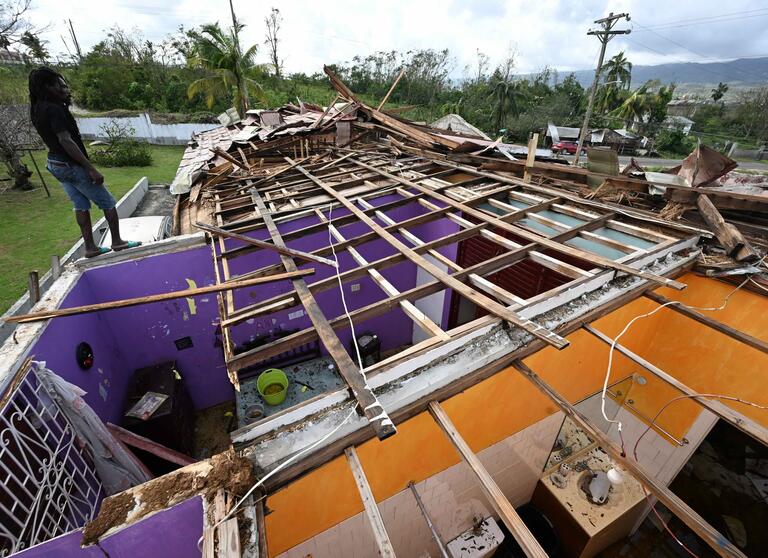

In a residential part of Westmoreland, a parish on the western point of Jamaica, Maceo Sibbles stands amid a swath of broken branches and fallen trees. Behind him, the trees that still stand are bent, twisted and stripped of their leaves and branches.
“The damage has been catastrophic,” says Sibbles, who serves as director of the Westmoreland Branch of the Jamaica Red Cross. Hurricane Melissa, the strongest Hurricane to ever hit Jamaica – and the third largest storm to ever be recorded in the Caribbean – has caused widespread destruction across the west of the country.
“You can’t capture it in pictures, not even videos, you need to see it with your own two eyes,” he says. “It’s really horrific.”
There are some areas of Westmoreland that are still completely inaccessible, ten days after the hurricane made landfall. People are desperately in need of the most basic amenities, having had their entire lives shattered, blown into the wind.
“We’ve had areas where the only thing left standing is the bathroom, the concrete bathroom that the person built. If it’s not concrete, it’s not there, everything else is flat."
“We’ve had areas where houses are primarily built with board and zinc and most of those are completely devastated,” Maceo says. “We are trying our best to reach out and get out into the communities but haven’t even gotten to the hills yet. We are getting reports of a lot of people have passed away due to the storm."
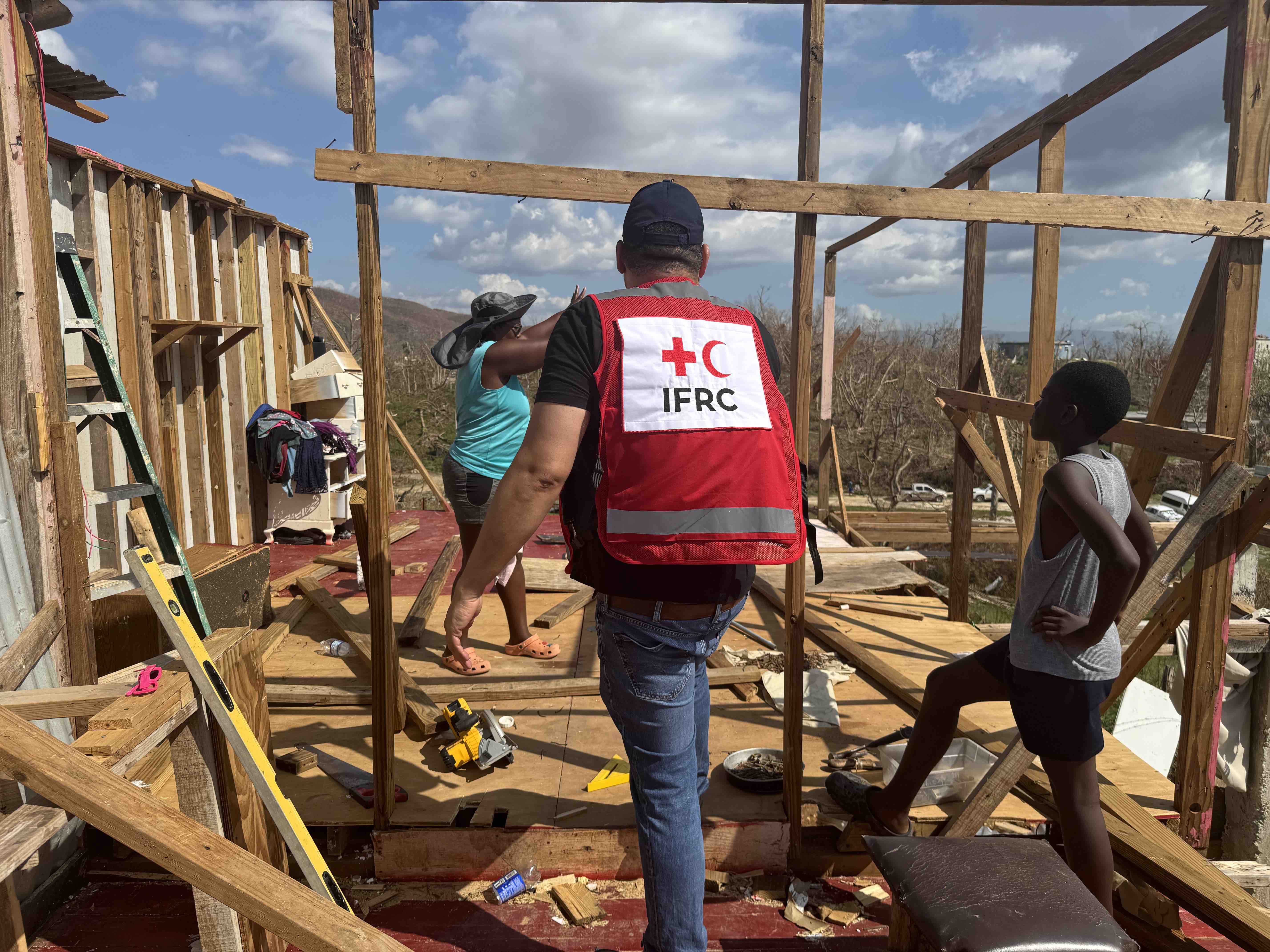
Hurricane survivor Marlene shows an IFRC staff member the near complete destruction of her home in Brompton, St. Elizabeth Parish in Western Jamaica. During the hurricane she sheltered with her three daughters in their concrete bathroom, the only room in their house still standing. Currently, the family are sleeping on the floor, on top of the clothes they managed to salvage.
Photo: Lauren Sabin/IFRC
‘Everyone is hurting’
Jamaica Red Cross staff and volunteers are currently facing immense challenges reaching affected areas due to downed power lines, flooding, and impassable roads. It took some volunteers several days to even reach their local Red Cross branch office to support with humanitarian aid distribution, because the areas surrounding their homes were so badly damaged.
“It took a lot of volunteers days to come out from where they were, getting through trees, getting through the downed powerlines on the roads,” Maceo says. “You can’t drive out, you have to walk out and then you’re dealing with water that is chest or waist height.”
“We have people who are marooned. We can’t get to them because of the distance to the closest driving point and it’s hard to go there and pass everybody on the way who can’t go out for themselves.”
Watch this interview with hurricane survivor Dwayne Francis:
Needs are vast: Emergency funding triggered and appeals launched
Despite the difficulties, Red Cross teams have started distributing goods to affected communities, including food packages, water and items like tarpaulins, shelter kits, hygiene kits, cleaning kits and jerry cans.
The needs are so vast it is impossible to reach everyone who needs support right now, so Maceo and his team are focusing on individuals and communities who are most vulnerable.
“We have started distributing to the elderly, people who have small children and people with disabilities, physical challenges or mental challenges,” he says. “We have also distributed from a location in Savanna La Mar for people who can actually reach there, to get some of their supplies.
To support the response to Hurricane Melissa in Jamaica, the IFRC has launched an emergency appeal for 19 million Swiss francs and allocated 80,000 Swiss francs from its Disaster Response Emergency Fund in advance of the storm's arrival in order to support emergency preparations.
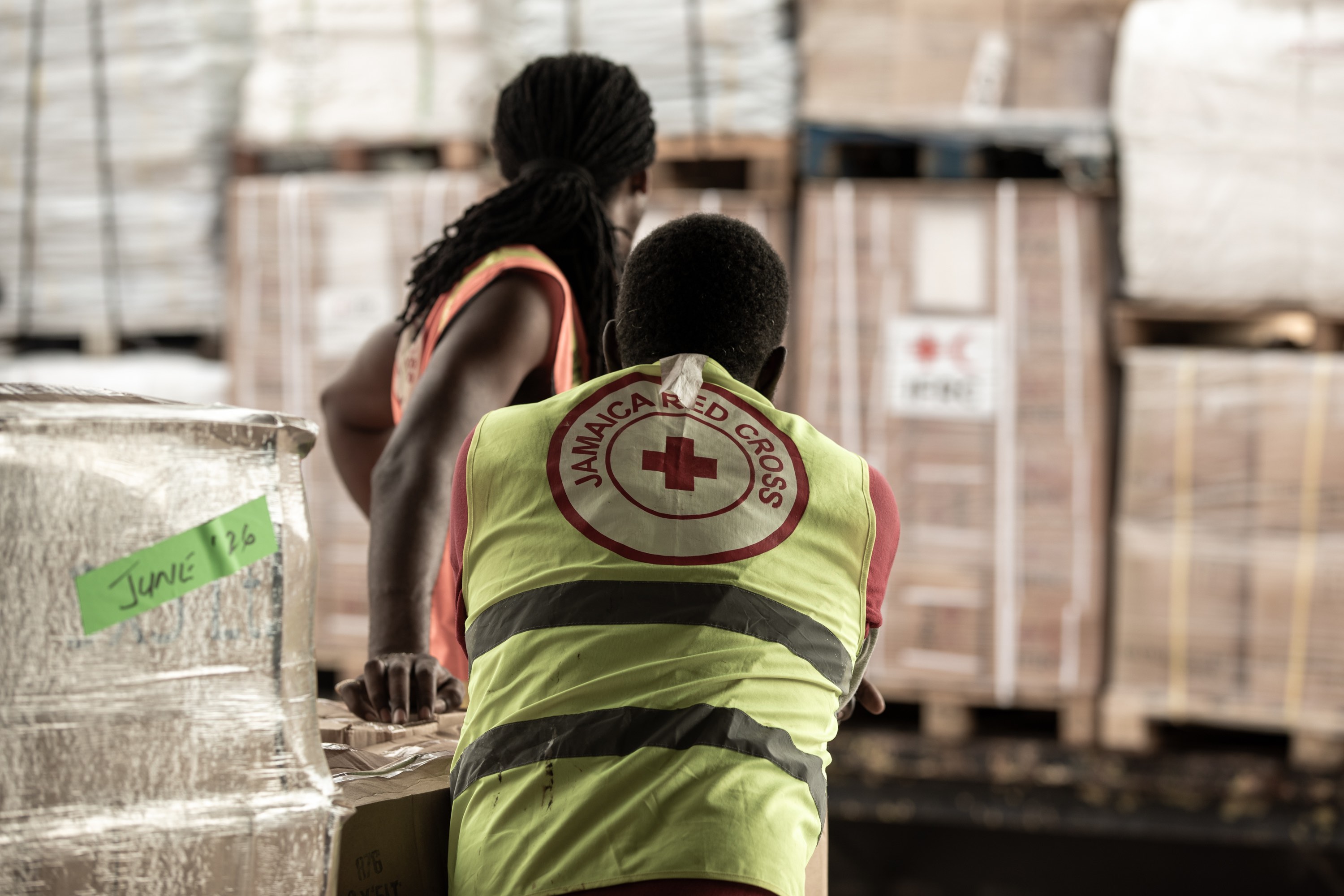
At the Jamaica Red Cross headquarters, volunteers unload 50 tons of critical supplies such as tarpaulins, hygiene kits, shelter kits, blankets and solar lamps into a warehouse before distribution. Supplied with support from IFRC, the items will help support 500 families.
Photo: Damien Fulton Naylor/IFRC
Working together
The scale of this disaster requires a coordinated response, with the many actors on the ground. Agencies need to ensure they are working together and pooling their resources to work as efficiently and effectively as possible.
“This is not the Red Cross only, it’s not the Ministry of Labour and Social Security only,” Maceo adds. “We’ve had World Central Kitchen come with hot meals, but everyone is chipping in little by little by little.
“I know some people are getting impatient and we can’t ask them to be patient; we just have to get to them as soon as we can. And that’s what we’re trying to do, day by day. We are going to keep pushing.”
In total, 881 shelters were activated across the island and are providing support to over 7,200 people. These shelters have largely been community halls, schools and churches, buildings that managed to withstand the force of the hurricane. Now, roughly 88 of these shelters remain active, with the Jamaican Red Cross managing eight of them.
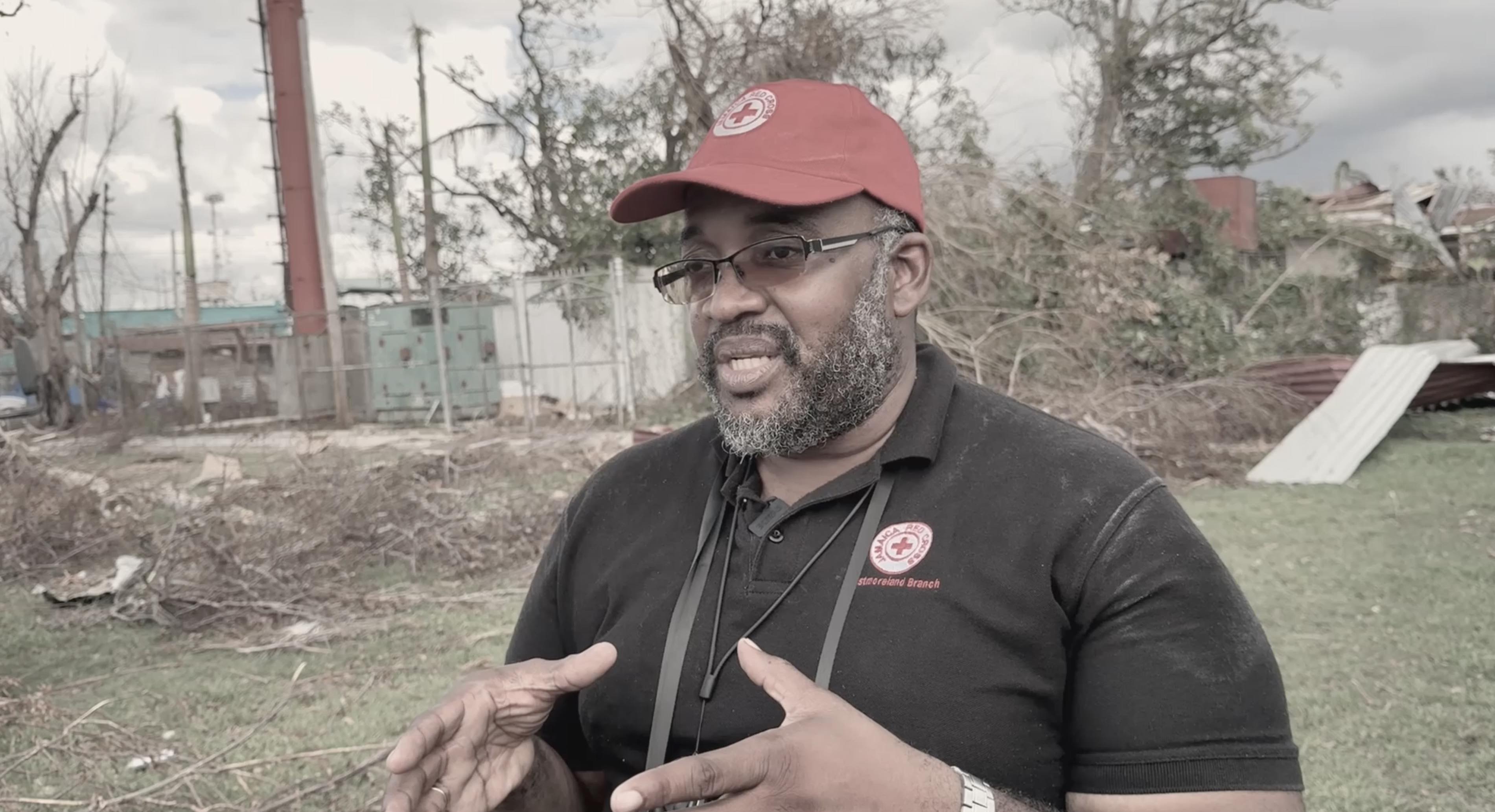
Maceo Sibbles, director of the Westmoreland Branch of the Jamaica Red Cross.
Photo: Lauren Sabin/IFRC
Community Resilience
Many of Maceo’s volunteers who are working tirelessly each day to provide food, supplies and other forms of help have also been badly affected. Despite their exhaustion and personal loss, they continue to support their neighbours.
“I know some of my volunteers have been working from 6 in the morning until twelve midnight and they are exhausted,” Maceo says. “We are trying to rotate through as much as possible, so there is no burn out, but on the ground, we are working as hard as we can, to get to people who need help.
“We have volunteers who are homeless right now. They are with somebody who may have gotten damaged and has pitched up part of their home to accommodate them.”
“We have volunteers who are homeless right now. They are with somebody who may have gotten damaged and has pitched up part of their home to accommodate them.”
“A lot of our volunteers, when they go home, they are going home to darkness, to no water, to mud, going through several feet of water just to get home. Our volunteers push, our volunteers work hard, they are volunteering from the heart.”
While Jamaica Red Cross volunteers are providing psychological support to people who are still living through a traumatic experience, they volunteers are also in need of psychosocial support.
“We are going to be doing a lot of psychosocial first aid, because this hurricane shook a lot of people,” says Maceo. “I was in it personally. It was terrifying. For me, I don’t panic but I know my daughter was scared. It was like nothing I’ve ever seen before.”
Another challenge communities worst hit by the Hurricane have been experiencing is telecommunication outages. There are many areas of the country that will be without power for weeks to come and so a network of satellite communication devices has started to emerge, spanning the length of the country. The Westmoreland branch has become a hub for one of these devices, called a Starlink.
“We’ve had the Starlink here for two days,” Maceo explains. “It’s being used by the community. We run it on the generator. It has issues but we’re really thankful for it. With the Starlink people are able to reach out to family members but also get some entertainment, because you know psychosocial support and people’s wellbeing is important. People need to have time to decompress and breathe, to achieve some semblances of normal life. It’s really important.”
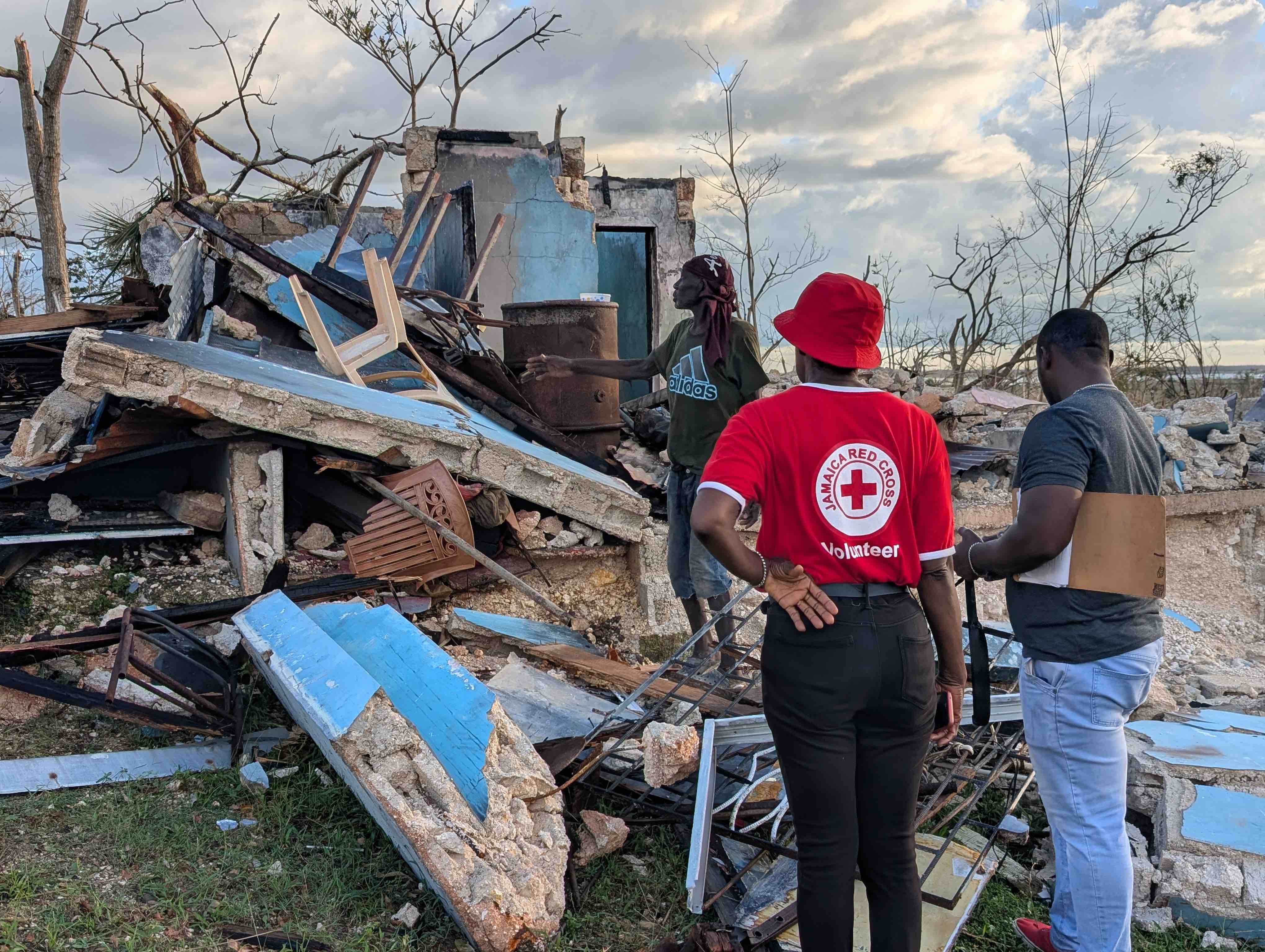
In the immediate aftermath of the storm, Jamaica Red Cross teams in St. Elizabeth conducted damage and needs assessments, which were followed by the distribution of food, hygiene items, cleaning kits, blankets, and tarpaulins.
Photo: Clarisse Smitas/Jamaica Red Cross
Hopes and fears
There are so many barriers to overcome and there will be bumps in the road to recovery. The true extent of the damage and secondary hazards are still being identified. One such area of concern for Maceo is waste management and sanitisation issues.
“I am worried about the disposal of waste,” he says. “We already had a problem with garbage being picked pre-Melissa, but now you have human waste and bodily waste, where people are utilising public spaces because they don’t have anything else.
“One of my greatest concerns is that it might turn into some kind of communicable disease. I think we need public education on the matter, and we need to figure out a way to help these people have better hygiene practices.
“Right now, people are just surviving, and you can’t look at a person whose surviving and tell them they need to do something different. We need to come up with a better option.”
In terms of his hopes, Maceo has faith that his country will recover. Jamaican people are resilient and if we can garner enough support from the international community, there will be a light at the end of the tunnel, he says.
“My hope is that we can build better, that we can do what needs to be done, so everybody gets the help that they need. I believe that we can do it, but we must get a lot of support,” he says.