
by Kate Forbes, IFRC President
Only two weeks ago, I was walking through the streets of Solferino during the Fiaccolata, surrounded by thousands of Red Cross and Red Crescent staff and volunteers carrying candles in memory of a simple but profound idea: that humanity must prevail, even in the darkest moments.
And just last week, in the deserted roads of Djibouti, I was reminded that humanity is something we choose. Every day.
Here, every single day, the staff and volunteers of the Djibouti Red Crescent bring humanity to people who need it most.
Djibouti is home to just over one million people. Situated at the crossroads of Africa, the Middle East and some of the world’s busiest migration routes, it is a country facing its own challenges: chronic poverty, the growing impacts of climate change, and economic hardship. Yet it remains a rare island of stability in an otherwise fragile region.
That stability has made Djibouti a critical corridor along the Eastern Migration Route. Every year, hundreds of thousands of people cross its territory, hoping to reach the Gulf countries in search of work and, for some, eventually Europe.
Last year alone, around half a million people travelled through Djibouti - equivalent to half the country’s own population. Yet this humanitarian reality rarely makes international headlines.
Beyond the numbers: individual stories
Behind that staggering number are individual lives. Around one in five people on the move are women. Many are children travelling alone or with limited support. Along the journey, they endure hunger, dehydration, exhaustion, exploitation, violence and profound psychological trauma. Their stories are often invisible, but their suffering is not.
Today, I joined one of the Djibouti Red Crescent’s mobile teams in Dikhil, a town in the western Dikhil region of Djibouti, bordering with Ethiopia. Before sunrise, volunteers loaded vehicles with water, food, hygiene kits and dignity kits before heading into the desert. At this time of year, temperatures regularly climb to between 45 and 47 degrees Celsius. Walking for days under such conditions is almost unimaginable.
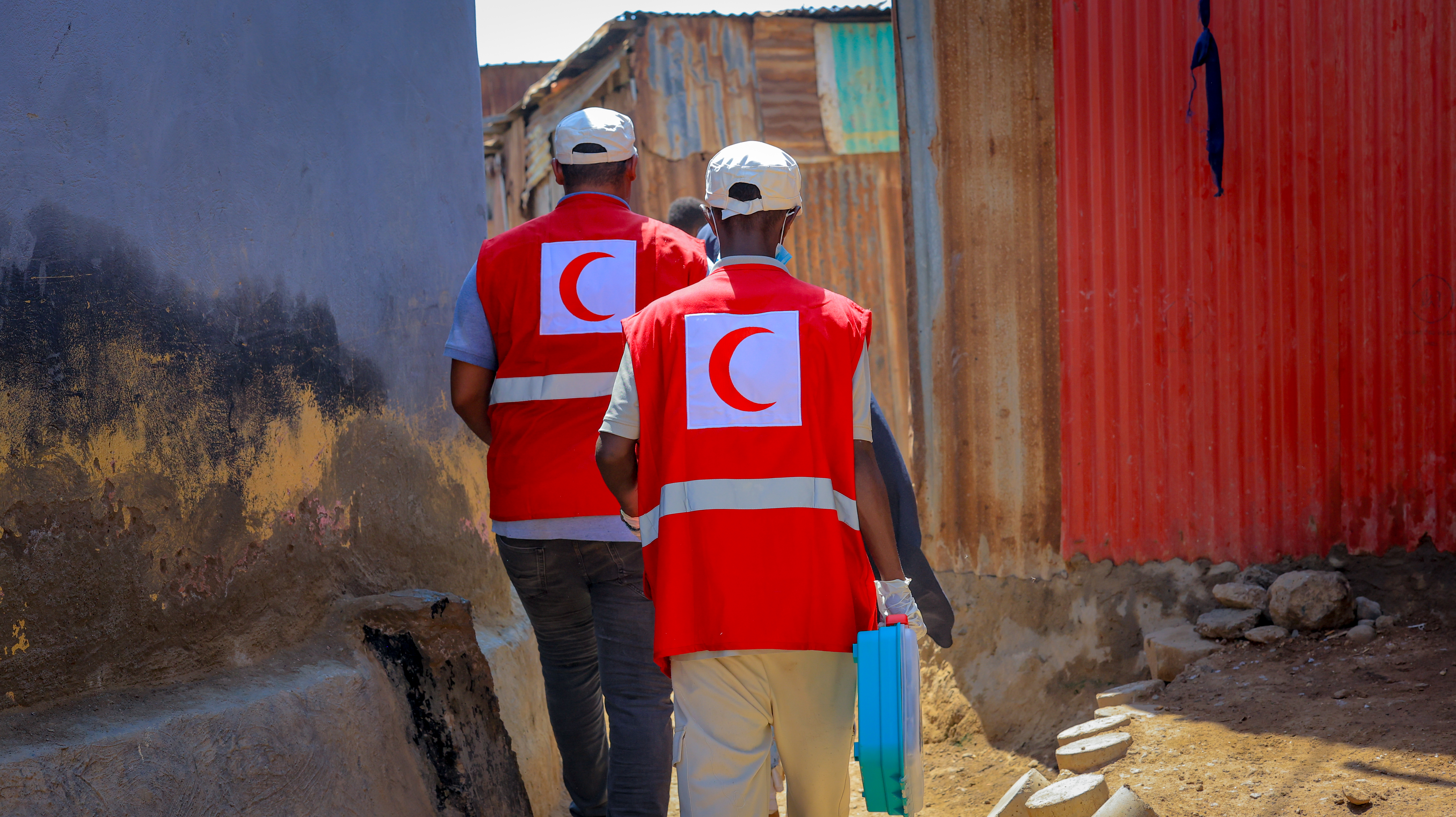
Two Djibouti Red Crescent volunteers on their way to provide support to people migrating through a section of the country with little water, food and other services.
Photo: Kamil Houmed Hassan/Red Crescent Society of Djibouti
They had been walking for eight days
Our first encounter was with a group of 10 young men. Among them was a fourteen-year-old boy. They had been walking for eight days. Their faces carried the unmistakable signs of dehydration, hunger and exhaustion. There was little need for words to understand what they had endured.
Later, we met another group - sixteen or seventeen women who had been walking together for five days. They had not started their journey together; they had simply found one another along the road. Strangers brought together by a shared search for hope.
As I listened to their stories, one woman quietly told us that she had left her one-year-old daughter behind.
She did not leave because she wanted to. She left because she believed that somewhere ahead there might be a chance to build a better future for her child and her family.
It is impossible not to wonder what kind of hope is powerful enough to make a mother walk away from her baby, trusting that separation today may mean opportunity tomorrow.
Every person we met carried a different story. There is no single profile of a person on the move. Some are escaping conflict. Others are fleeing poverty. Some seek employment. Others simply seek survival.
Not all will reach the destinations they dream about. Some will find work in Djibouti and decide to stay. Some will be unable to continue their journey. Some will return home and attempt the same journey again - twice, three times, or even more - because hope often survives where opportunity does not.
Throughout these journeys, the Djibouti Red Crescent remains one of the very few humanitarian organizations consistently present for people on the move.
Food, water and dignity
With support from the European Civil Protection and Humanitarian Aid Operations (ECHO), the Italian Red Cross and the International Federation of Red Cross and Red Crescent Societies (IFRC), its staff and volunteers provide far more than food and water. They offer dignity. They offer compassion. Above all, they remind people who are often forgotten that they have not been abandoned.
Humanitarian work is often measured in numbers: meals distributed, litres of water provided, people assisted.
But today reminded me that its true value is measured differently. It is found in a volunteer offering a bottle of water before asking any questions. It is found in listening to someone’s story without judgment. It is found in recognizing the humanity of someone whose name may never appear in a report or a headline.
The work of the Djibouti Red Crescent is remarkable, but it cannot continue without sustained support. Migration along this route may not dominate global attention, yet the humanitarian needs are immense and growing. If we believe that every life has equal value, then our solidarity cannot depend on whether a crisis captures the world’s headlines.
In the quiet places of the world, far from the spotlight, humanity is still walking. The least we can do is make sure it is never walking alone.